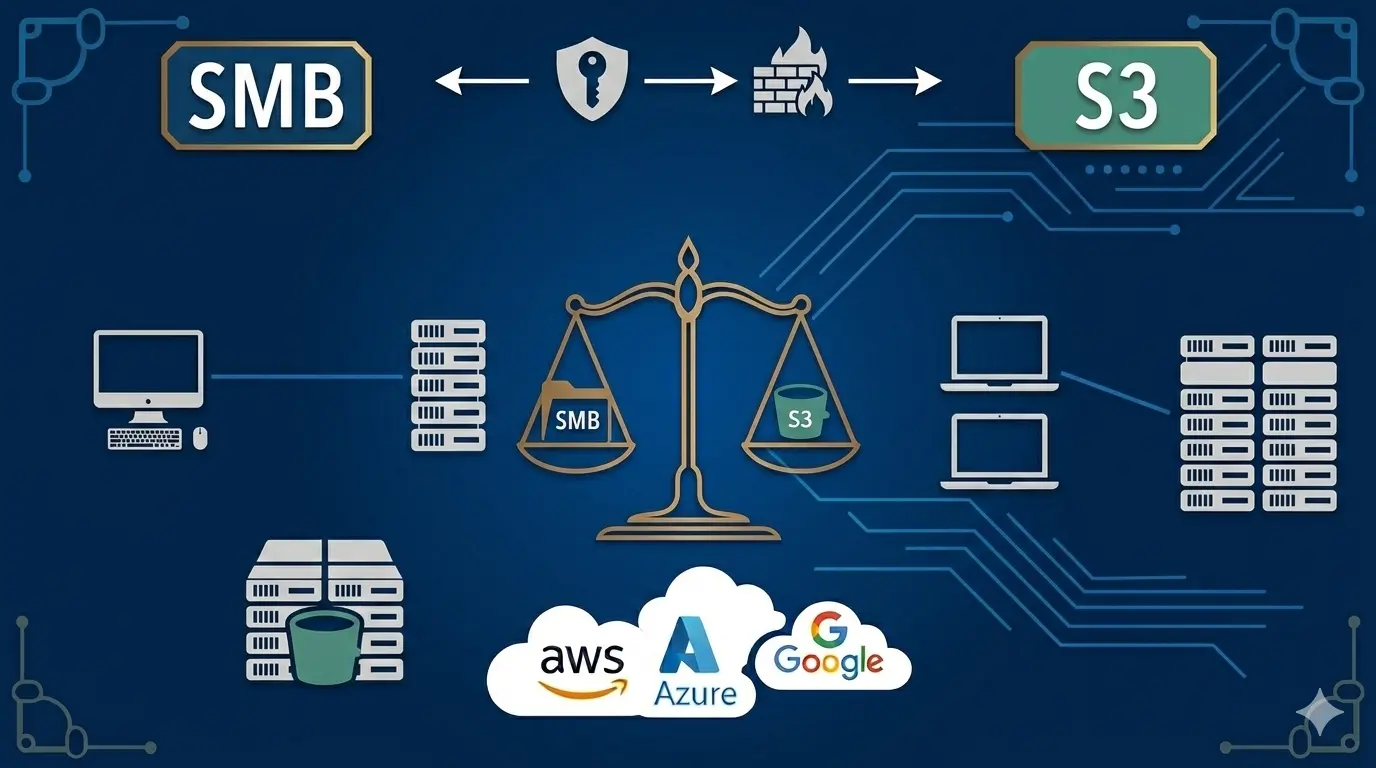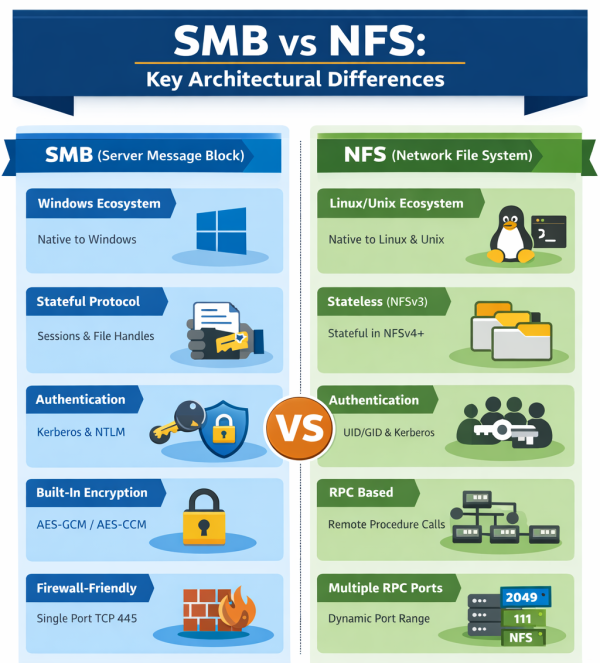

As organizations modernize their storage strategies, a recurring architectural question emerges: should we use Server Message Block (SMB) file storage or object storage such as Amazon Simple Storage Service (S3)?
This is not a protocol comparison at the feature checklist level. It is an architectural positioning discussion. Each model reflects a fundamentally different philosophy of data access, consistency, performance, and cost optimization.
Understanding where SMB and S3-compatible object storage fit is essential for hybrid cloud design, edge deployments, analytics pipelines, and AI workloads.
Two Storage Paradigms, Two Architectural Models
SMB – Stateful File System Semantics
Server Message Block is a stateful, session-oriented file sharing protocol designed to expose remote storage as a mounted file system.
SMB architectural characteristics:
- Hierarchical directory tree
- Strong consistency
- Byte-range locking
- Stateful sessions
- POSIX-like file semantics (depending on implementation)
- Native OS integration (Windows, Linux, macOS)
SMB behaves like a remote disk. Applications interact with files via open, read, write, lock, close operations. The abstraction is filesystem-centric.
This makes SMB ideal for:
- Enterprise file shares
- Collaborative document editing
- Media production workflows
- Embedded systems requiring deterministic file behavior
- Line-of-business applications expecting traditional file APIs
S3 Object Storage – Stateless Access
Amazon S3 represents a different model entirely. It exposes storage as objects in buckets, accessed via HTTP-based REST APIs.
S3 architectural characteristics:
- Object-based namespace (flat by design, with directory-oriented enhancements such as S3 Directory Buckets)
- Object-level operations
- Stateless transactions
- Eventual consistency model (depending on implementation)
- Optimized for scale-out and geo-distribution
Object storage does not expose a mounted filesystem. Instead, applications interact through PUT, GET, DELETE, and metadata operations.
AWS continues to evolve the platform. For example, Amazon S3 Directory Buckets introduce directory-oriented performance optimizations and high request-rate capabilities within a single availability zone. While these enhancements improve latency and small-object efficiency, the underlying model remains object-based and stateless rather than a traditional hierarchical filesystem.
This makes S3 ideal for:
- Cloud-native applications
- Backup and archive
- Data lakes
- AI training datasets
- Web-scale storage
Architectural Positioning – Control vs Scale
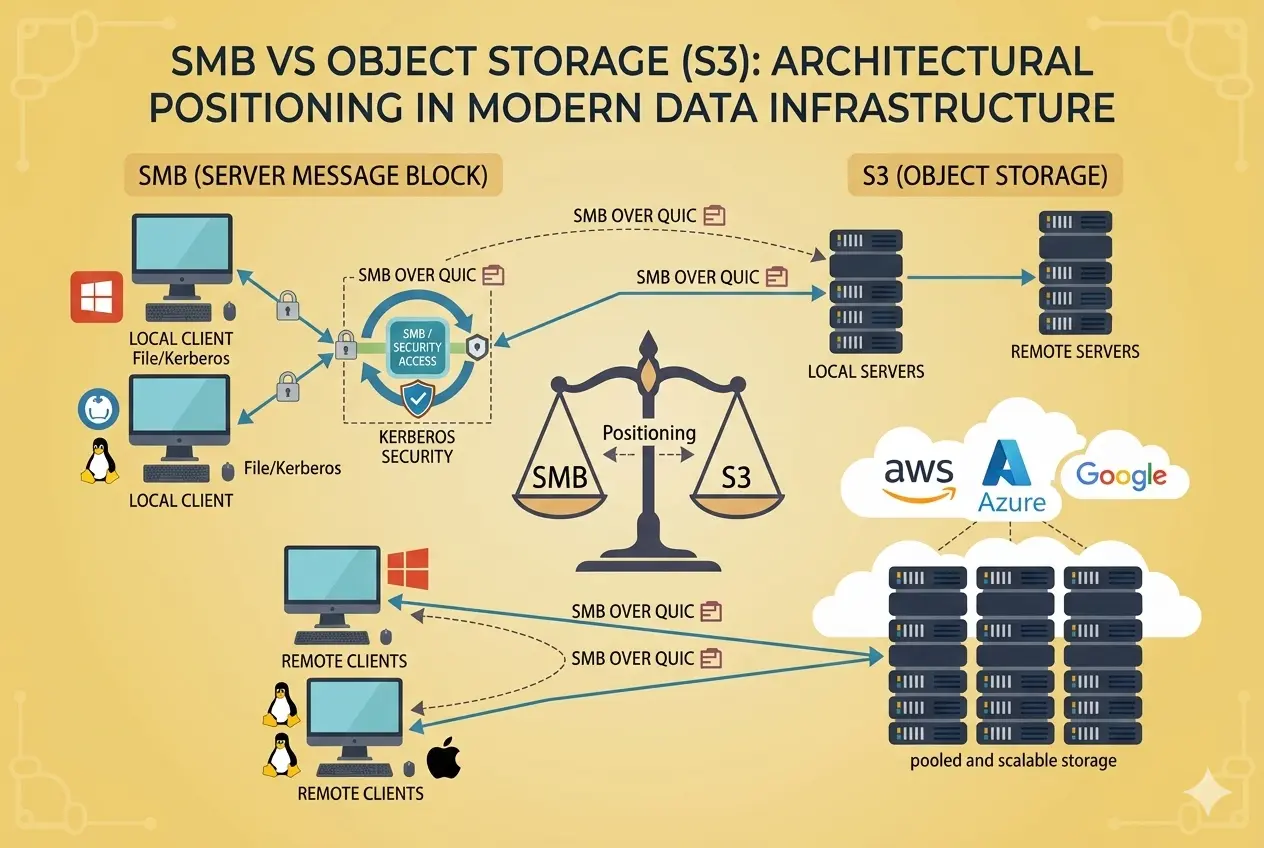
The architectural tension between SMB and S3 can be summarized as:
Dimension | SMB | S3 Object Storage |
Data Model | Filesystem | Object store |
Consistency | Strong | Often eventual |
Access Pattern | Stateful sessions | Stateless API |
Latency | Optimized for LAN | Optimized for internet scale |
Locking | Yes | No native locking |
Partial Updates | Efficient | Whole-object rewrite |
Cost Model | Capacity + infra | Capacity + API + egress |
Design Focus | Application compatibility | Infrastructure scalability |
Performance Considerations
SMB Performance Profile
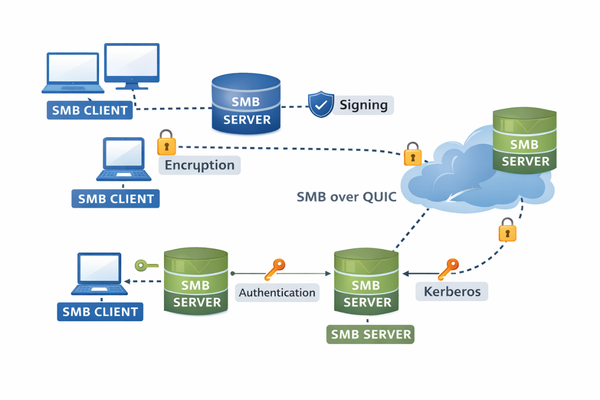
SMB 3.x supports:
- Multi-channel
- Encryption
- Signing
- Large MTU
- Credit-based flow control
- SMB over QUIC for secure WAN connectivity
It performs exceptionally well in:
- Low-latency environments
- High Input/Output Operations Per Second (IOPS) transactional workloads
- Incremental writes and small file operations
S3 Performance Profile
S3-style storage excels in:
- Large object throughput
- Parallel object access
- Geo-redundancy
- Horizontal scalability
However:
- Every operation is an API call
- Metadata operations incur cost and latency
- Small-file workloads can become inefficient
- Partial updates require full-object rewrite
For analytics and AI workloads that process large immutable datasets, object storage is ideal.
For interactive applications requiring file locking and random writes, SMB remains superior.
Cost Architecture – The Hidden Dimension
Many architectural discussions overlook the economic layer. With object storage, cost components typically include:
- Capacity (per GB)
- API requests (PUT/GET/LIST)
- Data transfer (especially egress charges)
- Cross-region replication
- Lifecycle transitions
With SMB-based storage:
- Infrastructure cost
- Capacity
- Network
In hybrid cloud deployments, data egress from object storage to on-prem systems can become a significant operational expense. Architecturally, this creates pressure to:
- Reduce unnecessary object retrieval
- Avoid chatty API patterns
- Optimize data locality
- Introduce smarter data access layers
This is where storage abstraction and multi-protocol strategies become increasingly relevant.
Application Compatibility: Refactor or Preserve?
A central architectural decision is whether to:
- Refactor applications to become cloud-native (object-based), or
- Preserve existing file-based semantics.
Rewriting mature systems to use object APIs is often expensive and risky. Many enterprise and embedded systems were designed around filesystem assumptions:
- Atomic rename
- File locking
- Append operations
- Partial writes
- Directory traversal
Object storage does not natively support these behaviors, therefore architects must evaluate:
- Development cost
- Risk exposure
- Time-to-market
- Operational complexity
Hybrid Architectures: The Convergence Pattern
Modern infrastructure rarely chooses exclusively between SMB or S3. Instead, we increasingly see:
- SMB at the edge
- Object storage in the cloud
- Data tiering strategies
- Caching layers
- Protocol gateways
- Unified access layers
The architectural challenge becomes: how do we allow applications to operate using file semantics while leveraging object storage economics and scale?
This is not a protocol war. It is a convergence problem. Forward-looking infrastructure design increasingly incorporates:
- Multi-protocol access
- Intelligent caching
- Egress-aware optimization
- Unified APIs
- Data movement abstraction
Organizations that treat storage protocols as interchangeable endpoints rather than rigid silos gain architectural flexibility.
Security Model Differences
SMB integrates deeply with enterprise identity systems:
- Active Directory
- Kerberos authentication
- NTLM fallback
- Access control lists (ACLs)
Object storage relies on:
- IAM policies
- Token-based access
- Bucket policies
- Signed URLs
Each model has strengths. However, the operational integration differs significantly.
In regulated industries, the integration of SMB with enterprise identity often simplifies compliance alignment.
When to Use SMB
Choose SMB when:
- Applications expect a mounted filesystem
- Strong consistency is required
- Locking is mandatory
- Incremental updates dominate
- Low-latency access is critical
- Legacy systems cannot be refactored
When to Use S3 Object Storage
Choose S3-compatible storage when:
- You need massive scalability
- Data is immutable or append-only
- Workloads are analytics-heavy
- Global distribution is required
- Infrastructure is cloud-native
- Lifecycle tiering is essential
Strategic Takeaway: Architect for Abstraction
The real architectural evolution is not SMB versus S3. It is about decoupling application semantics from storage backends.
Enterprises that introduce intelligent abstraction layers can:
- Reduce cloud egress exposure
- Minimize refactoring costs
- Optimize data locality
- Support multi-cloud strategies
- Enable protocol interoperability
The future of storage architecture is not binary. It is composable.
Final Perspective
SMB and S3 represent two valid, powerful models. The architectural question is not which one wins. It is how to position them correctly within your infrastructure stack.
Organizations that treat storage as a strategic architectural layer, rather than a protocol decision, will be better positioned for hybrid cloud efficiency, cost control, and long-term scalability.

Lilia Wasserman, VP R&D, Visuality Systems