


Why Open-Source Stitched Connectors Fail Under Production Loads

Many software development teams attempt to build file-sharing architectures by stitching together disparate open-source network protocol connectors. Under heavy production loads, these frameworks collapse due to silent socket leaks, unhandled Kerberos negotiation drops, and single-threaded CPU bottlenecks.

Modern enterprise application infrastructures frequently rely on a variety of network protocol connectors to coordinate files, databases, and remote storage volumes. When establishing cross-platform communication between Windows backends, cloud-based environments, and non-Windows client devices, developers often construct a mixed-quality connectivity stack by “stitching” together disparate open-source libraries. This structural approach typically combines open-source for Linux-based C-level environments, legacy libraries such as jCIFS or newer projects for Java applications, alongside separate components for File Transfer Protocol (FTP), Network File System (NFS), or cloud object storage.

While this stitched-together model appears cost-effective during initial development, it introduces severe integration friction over time. Open-source protocol libraries are built by different community groups, utilize incompatible Application Programming Interfaces (APIs), follow disparate performance paradigms, and offer no uniform support model. Under production loads, where high concurrency, network latency, and protocol complexity converge, these stitched connectors routinely fail.

The Server Message Block (SMB) protocol is highly complex, operating across multiple dialect versions (from SMB1 to SMB3.1.1) and relying on auxiliary sub-protocols including DCE/RPC, SPNEGO, NTLMSSP, Kerberos, and NetBIOS. Coordinating these elements requires deep, active management of the protocol state machine. When an organization relies on community-maintained libraries, it accepts significant risks, including unpatched vulnerabilities, unpredictable support lag, and version synchronization issues. Under production volumes, these vulnerabilities manifest as catastrophic failures: connection dropouts, authentication lockouts, and severe performance degradation.

Developers facing these production failures often realize that the total cost of ownership of open-source components exceeds that of a commercially supported stack.

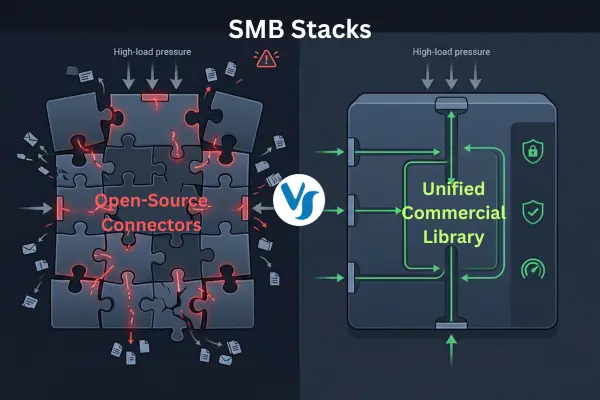
Architectural comparison of a failing stitched open-source network connector stack vs. a unified, high-performance commercial protocol stack under production load.

Stale Connections and Socket Leaks: The JVM Socket Illusion

In high-throughput Java applications, connection pooling is standard practice for optimizing network overhead. Some open-source SMB libraries implement caching mechanisms to store and reuse established TCP connections. However, the mechanical design of this cache may introduce a fundamental flaw when subjected to real-world network instabilities.

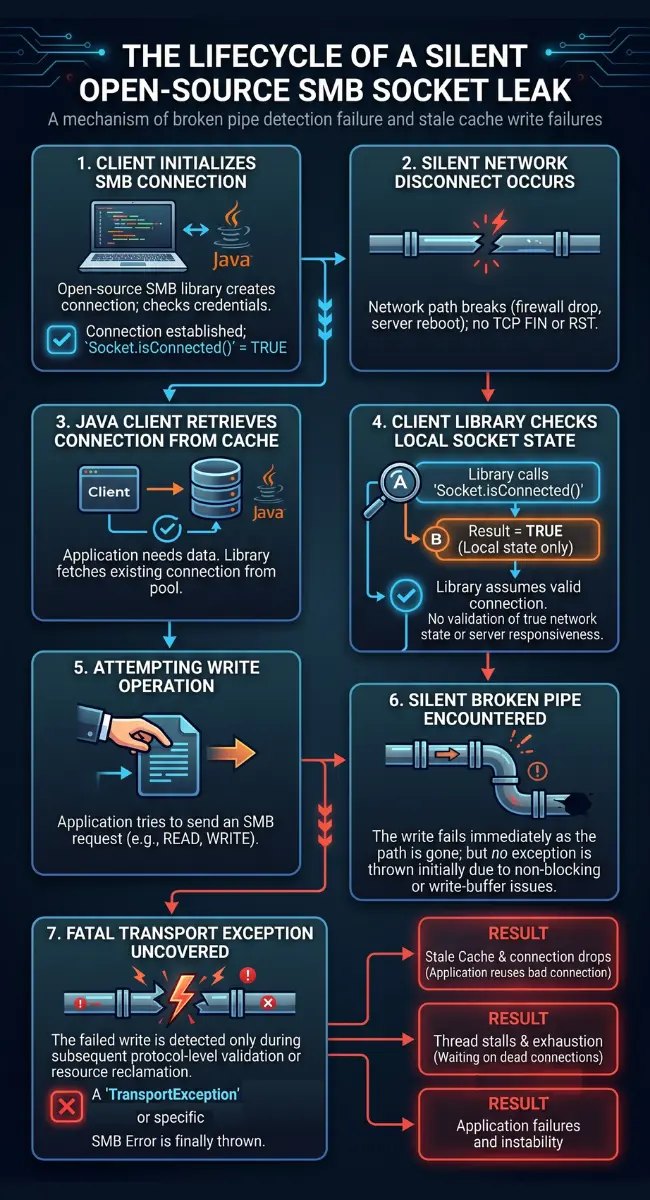
Before returning a cached connection, the client library must verify whether the connection is still alive. Open-source libraries typically attempt this by calling Java’s native socket verification methods. In Java, the native Socket.isConnected() and Socket.isClosed() methods only reflect the socket’s lifecycle as controlled by the local application code. They do not dynamically detect external network events, such as physical link disruption, firewall dropouts, or remote server restarts (such as idle disconnects).

The mechanical disconnect between the local JVM socket state and the actual physical network state comes down to a gap in awareness. The local JVM socket state merely reflects whether the connection was successfully established in the past, while the true network connection state depends on whether a physical, writeable path actually exists to the remote server at this exact moment. In an unstable or high-load environment, when the JVM believes the socket is connected but the physical network path is broken, a half-open or “broken pipe” state occurs. The client library continues to pull this stale connection from its connection pool or cache because the local socket check returns true. The true “broken pipe” is only discovered when the application attempts to write data over the wire. This results in immediate write failures, manifesting as unhandled exceptions in multi-threaded environments:

[Network/Transport Exception]: 
Cannot write payload with message ID [X] as underlying transport is disconnected.

To illustrate the technical differences between how local Java socket checks and actual network state behave under various production scenarios, see the comparison below:

Production Scenario

JVM Socket State (Socket.isConnected())

True Network Connection State

Resulting Client Library Behavior

Immediate Production Impact

Active Idle Connection

Connected

Available

Client safely reuses connection from the connection pool.

Normal operation; optimized throughput.

Server-Side Idle Disconnect

Connected

Broken

Client attempts to write using a stale connection reference.

Fatal transport exception during packet write.

Unannounced Server Reboot

Connected

Broken

Pool check passes; library tries to execute an initial handshake or session setup.

SocketException: Connection reset thrown to the application thread.

Firewall Silent Drop

Connected

Broken

Connection is assumed active; client waits indefinitely if socket timeout (soTimeout) is misconfigured or set to 0.

Complete application thread hang, leading to connection pool starvation.

Furthermore, high-level client libraries rarely perform an active “wire-level health check” (such as sending a low-overhead protocol ping or echo packet) before handing a connection to the application. When a silent disconnection occurs, the application layer is forced to catch the resulting transport exception, invalidate or evict the stale connection from the internal pool, and manually trigger a reconnect loop, a crude workaround that complicates application logic and increases operational latency.

See also: Troubleshooting Java SMB Integration Issues

DFS Cache Fragility: Silent Background Disconnects

The complexity of connection caching increases when dealing with Distributed File System (DFS) namespaces. In a standard, non-DFS SMB transaction, a connection failure is relatively easy to isolate because it occurs directly between the client and the target file server. If a write fails, the connection can be closed and rebuilt.

In DFS environments, however, the client library automatically handles referral resolution under the hood. When an application attempts to access a DFS share, the client library first connects to the DFS namespace server, requests a referral, and then automatically establishes separate, background TCP connections to the target data servers. The application is completely isolated from this process; it only maintains a reference to the main namespace connection.

Under production loads, this abstraction layer introduces severe vulnerabilities:

  1. Silent Target Server Disconnections: If one of the target background connections to a data server drops due to network instability or a server-side failover, the main namespace connection may remain perfectly healthy.
  2. Stale Cache Re-use: Because the main connection is healthy, the library’s internal connection pool continues to mark the DFS session as active.
  3. No Granular Recovery: Since the target connections are managed internally, the application cannot access or close the broken background connection directly.
  4. Disruptive Workarounds: The only available workaround in several open-source SMB client libraries is to completely tear down and recreate the main client or factory instance. This action forcefully clears the global connection cache, which inadvertently terminates all other active, healthy connections and abruptly aborts live, unrelated application sessions.


This limitation often leads to cascading failures in enterprise Java applications. A single network hiccup on a remote storage node can corrupt the client’s internal DFS routing table, forcing a complete client restart that interrupts all unrelated storage operations.

Authentication Deadlocks: Negotiation Failures in NTLM and Kerberos

Authentication in enterprise network directory systems requires strict compliance with SPNEGO (Simple and Protected GSS-API Negotiation Mechanism) wrappers, which negotiate between NTLM challenge-response and Kerberos tickets. Open-source libraries are prone to critical bugs when managing these complex security payloads under production volumes.

The Null Token Vulnerability

A notable example of version lag and community-driven regression occurred in a widely used open-source SMB client library. A change intended to optimize GSS-API token processing introduced a bug where the session negotiation engine attempted to serialize a raw authentication token without validating whether the buffer returned by the underlying security context was null. In environments utilizing specific Kerberos Key Distribution Center (KDC) configurations, this omission resulted in a fatal null pointer exception during the initial protocol handshakes:

[SPNEGO/Authentication Error]: 
Execution failed due to NullPointerException: Cannot read the array length because the token buffer is null during session setup token processing.

This bug entirely broke Kerberos integration for development teams updating their dependency stacks. It stands as a prime example of the operational risks associated with deploying uncertified open-source protocol updates in production environments, highlighting how a minor optimization in security token handling can inadvertently destabilize core authentication pipelines.

The NTLMv2 Domain Case-Sensitivity Bug

Legacy open-source SMB libraries also suffer from subtle protocol compliance deviations regarding security protocols. For years, the original jCIFS library contained an error where the target domain name was unconditionally converted to uppercase during NTLMv2 hash computation.

The NTLMv2 protocol relies on a cryptographic HMAC-MD5 calculation that binds the user password, the server challenge, and the target domain identity into a strict sequence. In this process, the cryptographic key itself is derived directly from a combination of the username and the domain name. Because the protocol dictates how case sensitivity should be handled for these fields, altering the text string changes the resulting cryptographic key.

If a strictly configured Active Directory domain controller expects the original case of the domain to be preserved, the forced uppercase conversion alters the expected key derivation. This discrepancy triggers a silent logon failure error code (STATUS_LOGON_FAILURE), leaving developers to debug seemingly correct credential strings with no obvious indication that a minor string manipulation within the jCIFS library broke the authentication hash.

Integrity Validation and MIC Failures

In modern open-source SMB library forks, attempts to support advanced security features like Session Message Integrity Code (MIC) validation have introduced performance bottlenecks and connection drops. When connecting to enterprise storage systems or strictly configured server environments, the client must validate the integrity token within the SPNEGO response to prevent protocol downgrade attacks.

Due to protocol parsing errors and incorrect parameter validations in some generic client implementations, this validation routinely fails. This mismatch throws generic errors indicating unsuccessful operations or signature validation failures. To bypass this, developers are often forced to explicitly disable security token integrity checks in the library configuration, an insecure workaround that exposes the enterprise network to man-in-the-middle exploits and compromises compliance with modern security standards (such as FIPS 140-3 or NIS2).

To detail these typical failure points across common open-source stacks, see the analysis of authentication errors below:

Library Context

Auth. Type

Error Signature / Exception

Root Cause Mechanism

Resolution Workaround (With Drawbacks)

Alternative Open-Source Library

Kerberos (via SPNEGO)

NullPointerException during token processing

Code fails to check for null buffers returned by the security context.

Downgrade library version or apply custom code patch.

jCIFS (Legacy)

NTLMv2

STATUS_LOGON_FAILURE

Unconditional conversion of the domain name to uppercase during cryptographic key derivation.

Migrate to a modern fork or manually modify target directory service case rules.

Modern Open-Source Fork

NTLMv2 with SPNEGO Integrity

Protocol Exception: Signature validation failed

Faulty validation of the integrity token against enterprise storage systems.

Disable integrity checks via configuration properties (Exposes security vulnerabilities).

Alternative Open-Source Library

Kerberos

SocketException: Connection reset

Lack of automatic clock synchronization with the key distribution center or bad host-to-realm mappings.

Manual OS-level configuration of environment configuration files and time synchronization.

Performance Degradation and Resource Exhaustion: Threading and CPU Bottlenecks

Under heavy production workloads, the architectural limitations of certain open-source client implementations can severely degrade performance, consume excessive CPU resources, and exhaust JVM threads.

The Single-Threaded Server-Side Bottleneck

For open-source server environments, standard community stacks often allocate a single thread or process per client connection. Under production loads, if a client application sends multiple concurrent requests (such as a multi-threaded crawling job scanning files) over a single connection, the server serializes these requests.

For metadata-heavy tasks, such as traversing directories to retrieve file modified times, the server must repeatedly execute a sequence of operations: open the target file, read the Access Control List (ACL), query extended attributes, and close the file. This serialized execution drives a single server CPU core to 100% utilization, creating a performance bottleneck for all concurrent users sharing that specific connection infrastructure.

JVM Thread Leaks in Open-Source Clients

On the client side, Java-based open-source implementations frequently struggle to manage thread pools efficiently during transport operations. For instance, generic architectures often spawn a dedicated background packet reader thread for every distinct network connection established. This background thread is responsible for reading incoming TCP segments and dispatching them to the application layer.

Under production loads, connection pool misconfigurations or slow network endpoints can cause these packet reader threads to leak:

  • Stuck Readers: If a remote server stops responding and the socket timeout is set to its default of 0 (which blocks forever), the background reader thread hangs indefinitely.
  • Thread Accumulation: As the application attempts to open new connections to handle pending transfers, more reader threads are spawned to handle the new sockets.
  • No Automated Reclamation: These background threads are often not reclaimed when the parent connection is abandoned by the connection pool, leading to rapid thread exhaustion.
  • JVM Thread Starvation: The resulting thread leak can saturate the host OS thread limit, causing JVM-wide starvation and crash failures.
[Thread State Error]:
"Background-Packet-Reader-Thread" ID: #X STATE: WAITING (on object monitor)
   at java.lang.Object.wait(Native Method)
   at [Library].transport.packet.Reader.doRead(SourceFile)

The Cost of Missing Flow Control

Many open-source client implementations lack robust, built-in flow control and transaction-level credit management. Modern SMB protocols dynamically negotiate credits to allow clients to throttle outstanding operations based on server load. While enterprise servers dynamically scale these windows up to a maximum (often thousands of credits), open-source clients frequently fail to track or renew these credits correctly.

Without mature credit management, open-source clients can overrun the server’s allocation windows or stall indefinitely when credits are exhausted, dropping network throughput to a fraction of the hardware’s actual capacity.

Compliance, Security, and Patent Vulnerabilities of Open-Source Libraries

Beyond operational failures, open-source stitched connectors introduce significant legal and compliance risks that can threaten an enterprise’s business model.

GPLv3 Copyleft and “Contamination” Risks

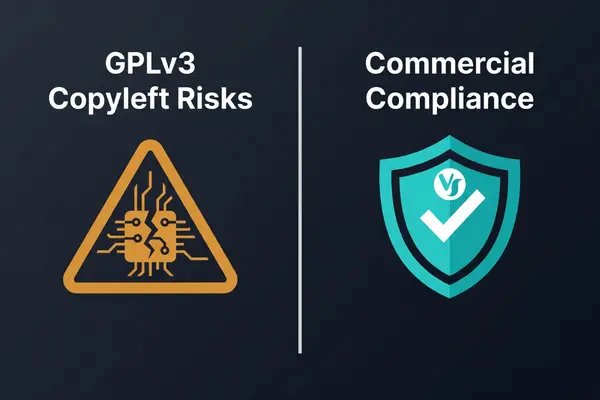
Samba – along with specific C-based components in its ecosystem – is licensed under the GNU General Public License (GPL) Version 3. GPLv3 enforces a strict “copyleft” provision, requiring that any derivative work containing GPLv3 code must also release its entire source code under the same GPLv3 terms.

For commercial enterprises developing proprietary software, this copyleft provision creates a major legal risk:

  • Static and Dynamic Linking: While dynamically linking an LGPL (Lesser GPL) library may protect proprietary code from copyleft terms, statically linking a GPLv3 component or interacting with it via “intimate” internal API calls can “contaminate” the proprietary application.
  • Compliance Audits: If a customer, competitor, or open-source advocacy group triggers a licensing audit, the enterprise may be legally forced to choose between publicly releasing its proprietary code or face immediate injunctions against distributing its product.

The Microsoft SMB Patent Liability

A more significant, often overlooked risk is patent infringement. The SMB protocol suite is developed, maintained, and copyrighted by Microsoft. Microsoft holds numerous patents covering key SMB capabilities, including session encryption, multi-channel bonding, and pre-authentication integrity.

Open-source projects are community-driven efforts. They do not include any patent licenses or indemnification agreements from Microsoft. Enterprises deploying these open-source stacks assume all patent infringement risks.

In contrast, commercial middleware providers include licensed Microsoft SMB patents in their software agreements, mitigating intellectual property risks and ensuring corporate adopters are fully authorized to use the protocol without fear of infringement claims.

Resource Footprint and Vulnerability Dense Architectures

Open-source stacks are often bloated, consuming excessive system resources and presenting a broad attack surface. For resource-constrained embedded platforms (such as medical equipment, HMI panels, and IoT devices), code footprint is critical.

Open source requires approximately 4.3 MB of ROM and 6.3 MB of RAM, making it unsuitable for lightweight real-time operating systems (RTOS) like VxWorks, QNX, or ThreadX.

Additionally, community-maintained code is highly vulnerable to security defects, introducing significant patching overhead for security teams.

Enterprise-Grade Stabilization via YNQ and jNQ

To eliminate the risks of stitched open-source connectors under production loads, enterprise software architects require highly optimized, commercially licensed middleware backed by professional SLAs.

Visuality Systems: The SMB Protocol Experts

Visuality Systems is recognized globally as the SMB Protocol Experts. For over 25 years, the company has developed robust, platform-independent, commercial SMB libraries deployed across hundreds of millions of enterprise devices worldwide.

By licensing commercial stacks from Visuality Systems, organizations gain access to optimized source code, 24/7 dedicated technical support, and comprehensive patent protection through an active Microsoft licensing partnership.

YNQ: The Embedded C-Based Standard

For C-based and real-time operating systems, the YNQ provides a highly portable, modular SMB Client and Server library. Designed specifically to run on resource-constrained platforms (such as VxWorks, QNX, Integrity, and legacy WinCE environments), YNQ features:

  • Minimal Footprint: Operates with a ROM footprint of just 860 KB (full dependency closure, including the authentication stack) and a RAM footprint of 5.66 MB (peak RSS, init/idle) compared to 24.9 MB for alternative open-source implementations.
  • Agile Codebase: ANSI C library with a clean Environment Abstraction Layer (EAL) for seamless porting to any proprietary platform.

jNQ: The Premier Java Solution

For modern enterprise Java backends and integration platforms, the jNQ is the definitive replacement for legacy, unmaintained libraries like jCIFS and fragile open-source alternatives. Written in pure, highly optimized Java (compatible with Java 1.8 and higher), jNQ delivers:

  • Robust Connection Pooling and Healing: Built-in, active wire-level checking and self-healing mechanisms that automatically detect and recycle stale sockets, preventing thread leaks.
  • Flawless Active Directory and Kerberos Integration: Fully verified SPNEGO and GSS-API engines that resolve the token parsing and signature validation issues common in open-source libraries.
  • Advanced Transport Add-ons (SMB over QUIC): The only Java library offering support for SMB over QUIC, enabling secure, low-latency, VPN-less connections over UDP port 443. An in-depth analysis of next-generation network transports is detailed in this article.


To evaluate the comparative architecture, security, and legal aspects of these options, see the protocol connector comparison below:

Technical Feature / Dimension

Open-Source Libraries

Visuality Systems Solutions (YNQ / jNQ)

Licensing Framework

GPLv3 / LGPL Copyleft (exposure risks).

Commercial, non-GPL, OEM-friendly.

Microsoft SMB IP Patents

None; end-user assumes all patent risks.

Bundled, official Microsoft SMB IP licensing.

SLA Technical Support

Community-based; no response guarantees.

Dedicated, 24/7 technical support experts.

ROM / RAM Footprint

Bloated (70 MB / 24.9 MB).

Ultra-lightweight (YNQ: 0.86 MB / 5.66 MB).

Thread & Socket Management

Fragile; prone to reader loops & socket leaks.

Thread-safe, active connection pooling.

Advanced Dialect Features

Limited; unstable DFS, no SMB over QUIC.

Full support for DFS, Multi-threading, & QUIC.

Technical flowchart showing the lifecycle of an open-source connection check, the failure of Java Socket isConnected checks, and the resulting stale cache write failures.

Strategic Recommendations for Enterprise Architects

Enterprises planning high-load distributed storage networks or embedding file-sharing into custom applications should adopt several critical design guidelines to ensure long-term stability, security, and compliance.

1. Enforce Protocol Modernization (Deprecate SMB1)

SMB1 is highly insecure, slow, and lacks modern features. To protect systems from vulnerabilities like WannaCry and NotPetya, enterprises must strictly enforce modern secure dialects:

2. Transition from NTLMv2 to Mutual Kerberos Authentication

NTLMv2 is vulnerable to offline cracking and relay attacks. To secure authentication, enterprise architectures should transition to Kerberos:

  • Integrate clients and servers directly with Active Directory or other identity management systems like FreeIPA.
  • Configure Kerberos authentication via SPNEGO, ensuring proper DNS reverse lookups and synchronized system clocks between client nodes and the KDC.
  • This transition prevents credential theft and ensures robust audit logs for Security Information and Event Management (SIEM) tracking.

3. Implement Active Connection Validation

To prevent stale socket leaks and thread hangs, avoid relying solely on basic local socket checks like Socket.isConnected():

  • Implement active “wire-level” checks, such as sending an SMB2Echo packet, before reusing cached connections.
  • Explicitly configure both transaction timeouts and socket read/write timeouts (withSoTimeout) to prevent thread starvation under load.
  • In Java environments, use structured try-with-resources patterns to ensure files, shares, and connections are closed correctly.

4. Leverage SMB over QUIC for Unstable Network Paths

For cloud-based storage, remote branches, or IoT endpoints communicating over public networks, bypass TCP limitations by adopting SMB over QUIC:

  • QUIC utilizes UDP port 443 and encrypts the entire transport session using TLS 1.3, eliminating the need for a VPN.
  • QUIC’s single-handshake connection establishment reduces latency compared to TCP.
  • Additionally, QUIC’s connection migration feature allows active sessions to persist uninterrupted even when client IP addresses change.


By replacing unsecure, unmaintained open-source connectors with Visuality Systems’ commercially backed YNQ and jNQ stacks, enterprises can eliminate performance bottlenecks, mitigate GPLv3 licensing and patent risks, and ensure reliable, secure file sharing under the most demanding production volumes.

Conclusion

The structural analysis of open-source stitched connectors highlights their critical vulnerabilities under high enterprise traffic. From silent socket drops and DFS connection caching leaks to severe authentication deadlocks and single-threaded CPU spikes, community-driven libraries frequently fail under production loads. For organizations looking to protect their revenue and secure their data pipelines, relying on community forums during an active production outage is an unacceptable risk.

Transitioning to Visuality Systems’ commercial middleware guarantees native, Microsoft-compliant connectivity, high concurrency processing, and comprehensive legal protection. Resolve your protocol challenges and secure your product roadmap by trying our enterprise-grade solutions. Contact our experts or try our software for free today.

Lilia Wasserman

Lilia Wasserman, VP R&D, Visuality Systems

Share Via
Related Articles

Visuality systems uses technical, analytical, marketing, and other cookies. These files are necessary to ensure smooth operation of Voltabelting.com site and services and help us remember you and your settings. For details, please read our Privacy policy

Skip to content