


May 2027 Is Official: Microsoft Sets Its First Hard Deadline for Mandatory NTLM Message Signing

With Nov 10, 2026 release of KB5135557 (CVE-2026-118737), Microsoft established its deadline for NTLM hardening. Beginning May 2027, Windows Server 2016-2025 will reject unsigned non-anonymous NTLM clients by default. How to audit Event ID 4023 and remediate legacy SMB and NTLM stacks.

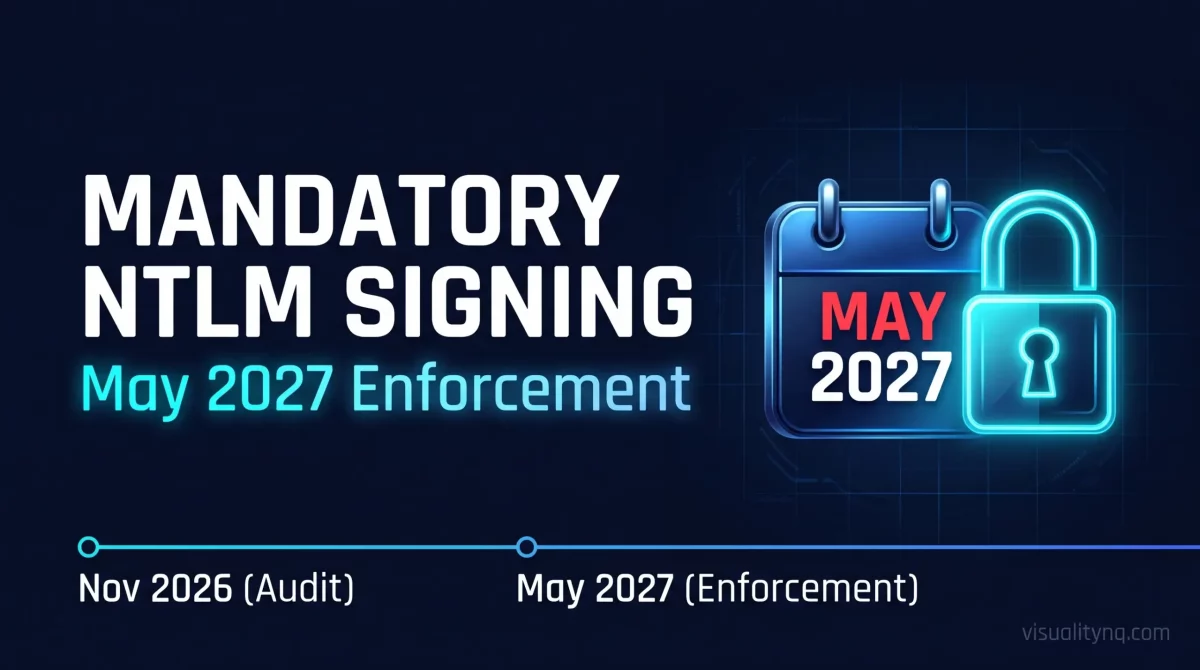
Mandatory NTLM Signing May 2027 Enforcement timeline showing November 2026 audit phase and May 2027 server enforcement deadline

For years, Microsoft’s broader NTLM retirement strategy – outlined under Advancing Windows security: Disabling NTLM by default – stopped short of naming a calendar date, tying default network NTLM disablement to “the next major Windows Server release and associated Windows client releases.” That changed with the November 10, 2026 security updates documented in KB5135557.

For the first time, Microsoft has attached a fixed six-month calendar deadline – May 2027 – to NTLM hardening, and it applies directly to supported, in-market Windows Server and Windows client operating systems via standard monthly servicing updates. Starting in May 2027, Windows servers will enforce NTLM message signing by default and reject non-anonymous, non-guest clients that fail to negotiate it.

Why This Announcement Is Different

1. A Fixed Six-Month Remediation Window Tied to CVE-2026-118737

Unlike long-term architectural deprecation roadmaps, KB5135557 ships as a security remediation addressing CVE-2026-118737, an NTLM cryptographic signature and relay vulnerability. Because the change closes an active protocol-level relay exposure, Microsoft structured the rollout around a strict two-phase timeline:

Rollout Phase

Effective Date

Default Behavior

Registry State (HKLM\SYSTEM\CurrentControlSet\Control\Lsa\MSV1_0)

Phase 1: Client Default + Audit

November 10, 2026

Windows clients offer cryptographic NTLM signing (NTLMSSP_NEGOTIATE_SIGN + NTLMSSP_NEGOTIATE_KEY_EXCH) on all non-anonymous connections. Servers accept both signed and unsigned clients and log auditing events.

ClientAllowUnsignedNtlm = 0 (default)


ServerRequireNtlmSign = 0 (default)

Phase 2: Server Enforcement

May 2027

Windows servers require NTLM signing by default. Unsigned non-anonymous, non-guest clients are rejected with SEC_E_UNSUPPORTED_FUNCTION (0x80090302).

ServerRequireNtlmSign = 1 (default)

(Note: Anonymous null sessions using ISC_REQ_NULL_SESSION and Guest account connections remain exempt from signing requirements in both phases because they do not establish a session key by design.)

2. Protocol-Layer Enforcement vs. Application-Layer Signing

Microsoft has previously enforced signing defaults for individual upper-layer application protocols – such as requiring SMB signing by default in Windows 11 24H2 and Windows Server 2025, or hardening LDAP signing and channel binding.

KB5135557 operates lower in the stack. It enforces cryptographic signing directly at the NTLM authentication layer (MSV1_0 / MS-NLMP) itself. Any legacy application, storage appliance, Linux/Samba host, multifunction printer, or network service authenticating via NTLMv2 – regardless of whether it runs over SMB, HTTP/407 proxies, RPC, or custom SSPI integrations – must establish a cryptographic session key and negotiate real message signing.

Furthermore, the scope spans almost every active enterprise Windows release:

  • Windows Clients: Windows 10 Enterprise LTSC 2021 and Windows 11 (versions 23H2 through 26H2)
  • Windows Servers: Windows Server 2016, 2019, 2022, and 2025

3. Distinct from the October 2026 NTLMv1 Enforcement

Administrators tracking Microsoft’s recent authentication changes should distinguish KB5135557 from the October 13, 2026 security update (KB5066470). That earlier milestone switched BlockNtlmv1SSO to Enforce mode by default on Windows 11 24H2+ and Windows Server 2025 (when Credential Guard is disabled). While KB5066470 specifically targeted legacy NTLMv1-derived credentials used in single sign-on workflows (such as MS-CHAPv2 Wi-Fi and VPN profiles), KB5135557 governs NTLMv2 message signing across the entire authentication subsystem.

Immediate Impacts Already Surfacing in Phase 1

Although servers are not yet rejecting unsigned clients, Phase 1 immediately changed client and SSPI behavior on November 10, 2026. Because Windows clients now advertise NTLMSSP_NEGOTIATE_SIGN (0x00000010) and NTLMSSP_NEGOTIATE_KEY_EXCH (0x40000000) by default:

  • Non-compliant NTLM servers and proxies: Third-party servers, custom NTLM listeners, or HTTP proxies that fail to echo the SIGN flag in their NTLMSSP_CHALLENGE (Type 2) message – or return an empty Target Info AV pair list – can cause modern Windows clients to fail authentication immediately.
  • SSO and authentication relays: Middlebox appliances and SSO agents that forward NTLM challenge-response exchanges without participating in the negotiated session key and MIC (mechListMIC) verification have already begun experiencing authentication failures following the November patch.


This immediate fallout highlights the risk of relying on static, unmaintained protocol implementations – such as legacy open-source libraries or minimal in-house NTLMSSP stubs – that fail to keep pace with Microsoft’s ongoing authentication hardening. Commercial protocol stacks that continuously track Microsoft specification updates, such as Visuality Systems’ YNQ (for C/embedded environments), jMount-SMB and jNQ (for Java), already handle full MS-NLMP session-key negotiation and cryptographic message signing out of the box, giving engineering teams a supported path for compliant NTLMv2 and Kerberos authentication.

Microsoft provides ClientAllowUnsignedNtlm = 1 as a temporary client-side compatibility override, though it disables signing across the entire host and will cease to work against patched Windows servers once Phase 2 takes effect in May 2027.
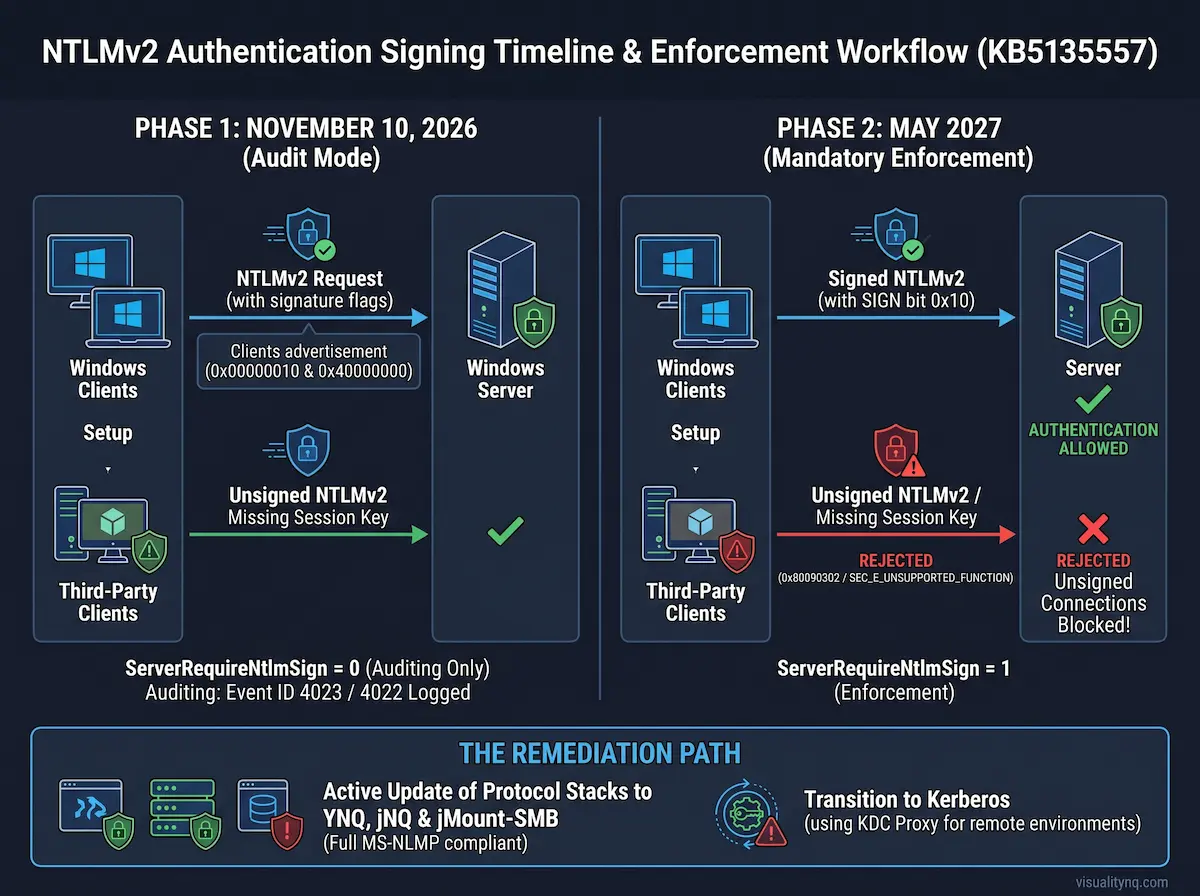

Technical diagram comparing Phase 1 November 10, 2026 audit mode with Phase 2 May 2027 mandatory NTLMv2 signing enforcement and remediation paths

Preparing Before May 2027: Auditing Event ID 4023

With six months remaining before enforcement, IT teams and embedded/appliance vendors have a clear diagnostic path in the Microsoft-Windows-NTLM/Operational event log:

1. Inspect Server-Side Event ID 4023 (and Client-Side Event ID 4022): On Windows Server 2019 and newer (with NTLM Enhanced Auditing enabled), inspect the Negotiated Flags and Session Key Status fields in Warning Event ID 4023. Note that both signed and unsigned NTLM logons log at the Warning level, so filtering by event severity alone is insufficient.

2. Verify the 0x10 (SIGN) Bit:

  • Phase 2-Ready: Negotiated flags such as 0xE0888215 include both 0x00000010 (NTLMSSP_NEGOTIATE_SIGN) and 0x40000000 (NTLMSSP_NEGOTIATE_KEY_EXCH), accompanied by Session Key Status: Present.
  • Will Break in May 2027: Negotiated flags such as 0xA0888205 lack the 0x10 bit (the 7th hex digit is 0 rather than 1) and report Session Key Status: Missing. Having NTLMSSP_NEGOTIATE_ALWAYS_SIGN (0x00008000) set without 0x10 provides no cryptographic protection and will be rejected in Phase 2.


3. Remediate or Migrate Legacy Stacks: For Windows Server 2016 hosts (which lack Event ID 4023 enhanced flag logging) and any non-compliant appliances or applications flagged in 4023 logs, organizations face two choices before May 2027: either upgrade the client’s SMB/NTLM implementation to support true cryptographic signing or transition those workloads to Kerberos (including IAKerb or a Windows Server KDC Proxy for environments without direct Domain Controller line-of-sight).

  • Upgrade the protocol stack: Replace legacy open-source SMB libraries (such as older JCIFS implementations) or custom NTLM handlers with a fully compliant, actively maintained stack. For Java applications, jNQ provides a drop-in SMB 3.1.1 client with full NTLMv2 cryptographic signing, AES-GMAC signing, and enterprise Kerberos support. For embedded Linux, RTOS, and storage appliances, YNQ delivers an ANSI C SMB client/server implementation engineered to stay aligned with Microsoft’s latest SMB and authentication specifications.
  • Standardize authentication across multiple backends: For Java architectures integrating SMB alongside cloud storage or other file protocols, jMount abstracts protocol-specific authentication behind a unified credential and session model – mapping natively to Kerberos and modern auth standards without forcing application-level rewrites every time Microsoft tightens protocol defaults.


4. Enable Enforcement Early on Validated Servers: Once Event ID 4023 auditing – or Microsoft’s KB5135557 audit PowerShell script – confirms zero unsigned NTLM connections, administrators can set ServerRequireNtlmSign = 1 (no reboot required) to close the relay window ahead of the May 2027 automatic cutover.

What This Means for Embedded and Third-Party Systems

For device manufacturers, storage vendors, and enterprise software teams, May 2027 removes the option of relying on minimal NTLMv2 stubs that negotiate authentication without session-key exchange and message signing. Any third-party client stack – whether in an RTOS device, embedded Linux appliance, NAS, or Java/C file-sharing integration – that connects to a patched Windows Server 2016–2025 host without setting NTLMSSP_NEGOTIATE_SIGN (0x10) and NTLMSSP_NEGOTIATE_KEY_EXCH (0x40000000) will be turned away at the protocol handshake.

Keeping pace with Microsoft’s accelerating security cadence – from NTLMv1 enforcement in October 2026 to mandatory NTLM signing in May 2027 and the eventual retirement of NTLM in favor of Kerberos – requires protocol infrastructure that evolves alongside Windows. Whether you are shipping embedded C firmware with YNQ, modernizing Java file sharing with jNQ, or unifying multi-protocol access across SMB and cloud repositories with jMount, Visuality Systems’ libraries are continuously updated and tested against current Windows releases so your integrations stay compliant before enforcement deadlines hit.

Frequently Asked Questions

When does Microsoft enforce mandatory NTLM message signing?

Under KB5135557 (published November 10, 2026), Microsoft enforces mandatory server-side NTLM message signing (ServerRequireNtlmSign = 1) starting in May 2027 across Windows Server 2016, 2019, 2022, and 2025.

What error occurs when an unsigned NTLM client connects in May 2027?

Starting in May 2027, Windows servers reject non-anonymous, non-guest clients that fail to negotiate NTLM message signing with error SEC_E_UNSUPPORTED_FUNCTION (0x80090302).

How can administrators audit unsigned NTLM connections before May 2027?

Administrators can inspect Event ID 4023 on Windows Server 2019 and newer (and Event ID 4022 on clients) in the Microsoft-Windows-NTLM/Operational log to verify whether Negotiated Flags include the 0x10 (NTLMSSP_NEGOTIATE_SIGN) bit and Session Key Status is Present.

Are anonymous or Guest NTLM connections affected by KB5135557?

No. Anonymous null sessions (ISC_REQ_NULL_SESSION) and Guest account connections remain exempt from NTLM signing requirements in both Phase 1 and Phase 2 because they do not establish a session key by design.

Lilia Wasserman

Lilia Wasserman, VP R&D, Visuality Systems

Share Via
Related Articles
Skip to content