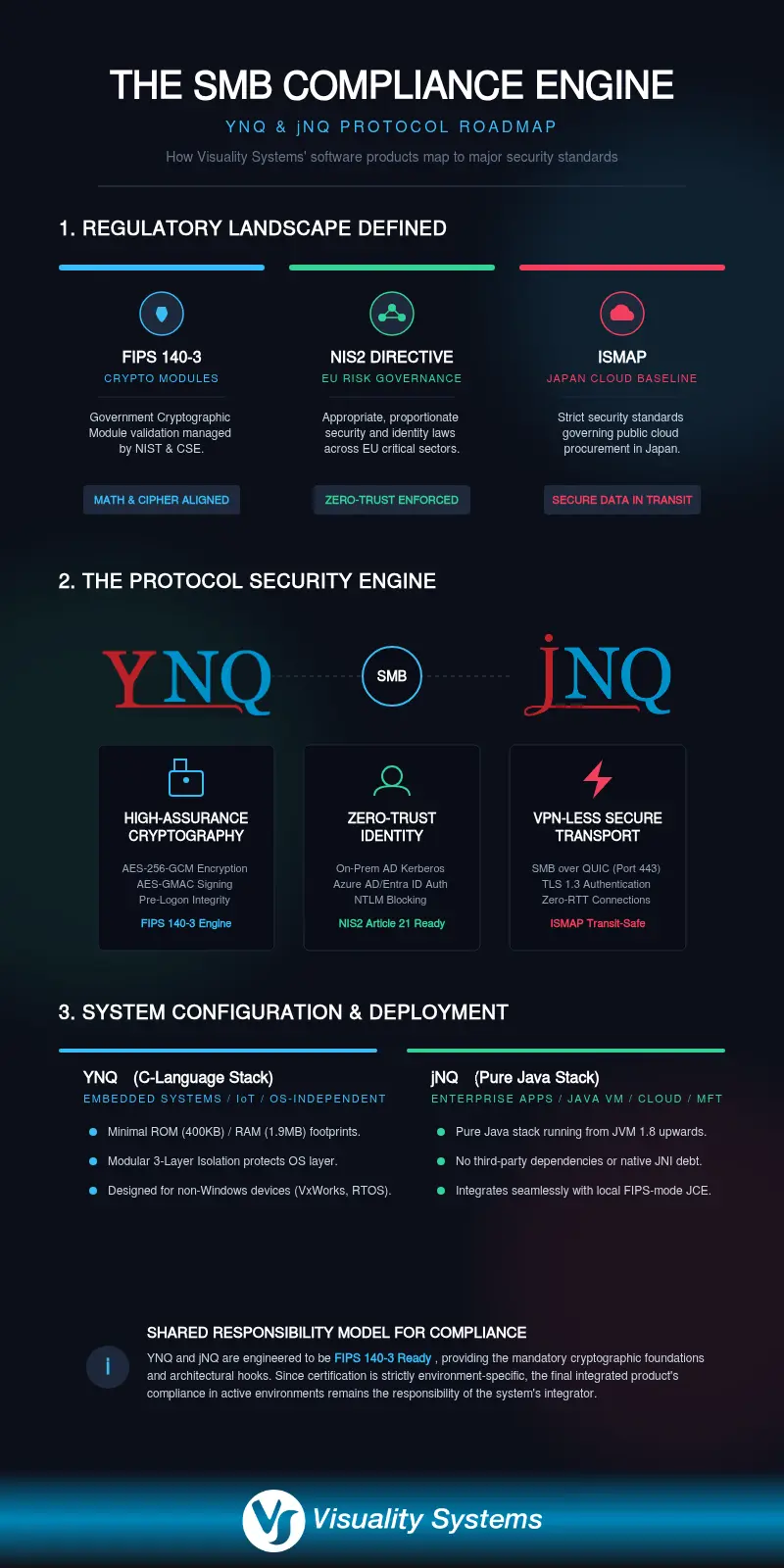



In the current global network security landscape, the transition from interpretive guidelines to rigid, enforceable regulatory frameworks is nearly complete. As embedded systems and enterprise applications become increasingly interconnected, the protocols governing their communication, most notably the Server Message Block (SMB) protocol, have moved to the forefront of compliance audits. For organizations navigating the complexities of FIPS 140-3 in the United States, the NIS2 Directive in the European Union, and ISMAP in Japan, the choice of an SMB implementation is a strategic compliance decision.
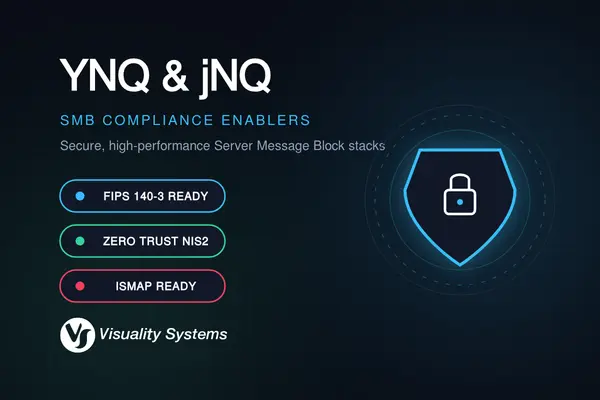
Visuality Systems’ YNQ and jNQ products act as critical enablers in this environment. By providing high-assurance cryptographic engines and identity-centric authentication mechanisms, these solutions allow manufacturers and enterprises to satisfy the technical requirements of global security standards.
Technical Foundations: How YNQ and jNQ Facilitate Compliance
The facilitation of these standards is rooted in the technical architecture and features of Visuality Systems’ SMB software libraries. Both YNQ (C) and jNQ (Java) were developed to replace vulnerable legacy implementations with a “Security-First” approach.
1. FIPS 140-3 Readiness through High-Assurance Cryptography
YNQ and jNQ provide native support for AES-256-GCM encryption and AES-GMAC signing. In the context of FIPS 140-3, these are the “approved” algorithms required for high-assurance data protection.
YNQ’s modular architecture is a key factor here; by isolating cryptographic operations in the “Service” level, it allows developers to point the stack toward FIPS-validated cryptographic libraries or hardware modules, ensuring the entire system meets federal requirements. Similarly, jNQ leverages the Java Cryptography Extension (JCE), which can be configured to run in FIPS mode, ensuring session keys are generated according to validated procedures.
2. NIS2 Facilitation via Zero Trust and Access Control
Article 21 of the NIS2 Directive mandates strict access control and identity management. YNQ and jNQ support Kerberos authentication against both on-premises Active Directory and Microsoft Entra ID (formerly Azure AD).
By moving away from legacy guest access and static keys which bypass signing and encryption, these stacks ensure that every connection to a shared folder is uniquely authenticated and authorized. This identity-centric approach is vital for preventing lateral movement, a major risk in the industrial and corporate networks targeted by NIS2.
3. ISMAP Readiness via Secure Transport (SMB over QUIC)
For ISMAP registration, protecting data-in-transit is critical, especially when cloud services are accessed via public networks. YNQ and jNQ offer SMB over QUIC as a modern solution.
By utilizing UDP Port 443 and the QUIC transport protocol, these products provide VPN-grade encryption without the configuration complexity of a traditional VPN. The QUIC handshake utilizes TLS 1.3 authentication, ensuring server identity is verified before data exchange, directly aligning with ISMAP’s data-in-transit protection guidelines.