
The Memory Wall: Data Volumes Exceed Hardware Capacity to Process Them

The 2026 memory crisis, fueled by AI data demand and chip scarcity, has turned RAM into a critical bottleneck. Learn how specialized SMB middleware like YNQ and jNQ provides a definitive hardware hedge, optimizing performance while reducing infrastructure costs.

The global technological landscape in 2026 is defined by a paradox of unprecedented growth and debilitating scarcity. As we navigate the “Great Silicon Realignment,” the industry is witnessing a structural shift driven by the explosive proliferation of Artificial Intelligence and a simultaneous, systemic shortage of semiconductor memory. The traditional cyclical nature of the chip market has been replaced by a “supercycle” of reallocation, where the demands of AI hyperscalers for High-Bandwidth Memory (HBM) have cannibalized the production capacity formerly reserved for consumer and enterprise hardware. This convergence of factors has birthed the “Memory Wall,” a point where data volumes exceed the physical and economic capacity of hardware to process them (IDC), transforming protocol-level efficiency from a technical optimization to an important strategy for maintaining organizational continuity.

A banner illustrating the AI Data and the Silicon Shortage bottleneck. Glowing streams of data (marked AI Demand) from an AI Cloud collide with a constricted pipeline that represents a jagged Memory Wall and Silicon Scarcity, causing Rising Costs. Efficient protocol middleware symbols demonstrate optimizing the data flow through the obstruction.

The AI Data Deluge: 100 Million Tokens and the Context Crisis

The primary catalyst for this shift is the transition from simple generative models to “Agentic AI,” autonomous systems capable of multi-step reasoning and coordinating swarms of sub-agents. These workloads have pushed data volumes beyond traditional limits. Worldwide IT spending is projected to hit $6.31 trillion in 2026, a 13.5% increase from 2025, with data center systems alone experiencing a staggering 55.8% growth rate (Gartner).

The technical challenge lies in the “context window.” Analysts at Third Bridge note that enterprise context windows have expanded from 100,000 tokens to over 100 million tokens in less than 24 months. Maintaining these windows requires massive Key-Value (KV) caches, which are extremely memory-intensive. When GPU memory (HBM) fills up, the system is forced to evict this data, leading to a “prefill tax” where the model must recompute old data from scratch, adding massive latency and cost to every inference request.

The 2026 Memory Crisis: Semiconductor Economics and Hyper-Inflation

The current global memory shortage is not a temporary supply chain hiccup but a fundamental rewriting of semiconductor economics. Three manufacturers, Samsung Electronics, SK Hynix, and Micron Technology, control over 95% of the DRAM market, and all three have aggressively pivoted their production toward HBM to capture the 70% operating margins offered by AI customers (Channel Insider).

This pivot creates a zero-sum game: producing one gigabyte of HBM consumes approximately three times the silicon wafer capacity of standard DDR5 memory. Consequently, as hyperscalers like Microsoft and Google lock in long-term contracts, the effective supply of conventional DRAM and NAND for the rest of the world is shrinking.

Component Type

Mid-2025 Pricing

Late 2025 Pricing

Q2 2026 Forecast

DDR5 32GB Kit (Consumer)

$95

$400

$550 – $600

16Gb DDR5 Chip (Enterprise)

$6.84

$27.20

$30 – $50

DRAM Contract Price (QoQ Change)

+15-18%

+55-60%

+90-95%

NAND Flash (Enterprise SSD)

Baseline

+53-58%

+130% (YoY)

Sources: IDC, Gartner, and TrendForce Market Analysis 2025-2026.

The fallout is widespread. In the PC and smartphone markets, average selling prices (ASPs) are rising as memory now accounts for up to 35% of the total bill of materials (BOM), a doubling from 2024 levels (HP). Gartner predicts that the sub-$500 entry-level PC segment will essentially disappear by 2028 because manufacturers can no longer absorb these costs.

Scaling the Memory Wall: Why Hardware Alone Isn’t the Answer

As processors execute instructions faster than memory can supply data, high-cost GPUs often sit idle, a phenomenon known as “GPU Starvation”. This infrastructure bottleneck is compounded by the fact that traditional enterprise storage was designed for sequential read/write patterns, not the extreme parallelism and sub-millisecond latency required by AI swarms.

To navigate this environment, organizations are increasingly looking beyond hardware-only solutions. While the industry waits for new fabrication plants to reach volume production in late 2027 or 2028, the most immediate mitigation path involves software-defined efficiency and protocol-level optimization. By reducing the memory footprint of data management and file-sharing tasks, enterprises can maximize the utility of their existing infrastructure despite the ongoing chip shortage.

Mitigating the Crisis with YNQ: Efficiency for Embedded and IoT Systems

In the world of Internet of Things (IoT) and embedded devices, the memory crisis is an existential threat. OEMs are facing a choice: build cloud-dependent devices that incur high operational costs, or build edge AI devices that require expensive, scarce local memory. Visuality Systems’ YNQ solution provides a third path by dramatically reducing the memory footprint required for robust file sharing and management.

Written in ANSI C and hardware-independent, YNQ is a commercial SMB stack that enables devices to remotely browse, read, and write files without the need to transfer the entire file to local memory.

Resource Parameter

Visuality Systems YNQ

Open-Source

ROM Footprint

400 KB

4,300 KB

RAM Footprint

1.9 MB

6.3 MB

Footprint Reduction

~10x

Baseline

By utilizing YNQ, manufacturers can maintain advanced SMB 3.1.1 connectivity on lower-density memory modules, effectively bypassing the most expensive segments of the RAM market. Furthermore, YNQ’s support for SMB over QUIC (UDP/443) provides a high-performance, VPN-less alternative for secure public-network access, reducing the protocol overhead on mobile and edge devices.

Mitigation with jNQ: Modernizing Enterprise Java Environments

For enterprise software developers, the memory crisis has turned technical debt into a financial liability. Some legacy Java applications still rely on aging SMB libraries, like JCIFS. Visuality Systems’ jNQ serves as the industry’s top-priority replacement, bringing full SMB 3.1.1 capabilities to Java 1.8+ environments while significantly optimizing resource consumption.

jNQ mitigates the memory crisis through the following key technical mechanisms:

  1. Decoupled Architecture: Unlike legacy libraries, jNQ uses a Client → Connection → Session → Share hierarchy. This allows a single physical connection to maintain multiple authenticated sessions, drastically reducing the handshake overhead and memory consumption associated with repeated setups.
  2. Asynchronous Multi-Threading: jNQ supports both synchronous and asynchronous I/O, allowing applications to handle multiple file shares simultaneously without blocking threads or wasting memory on idle cycles.
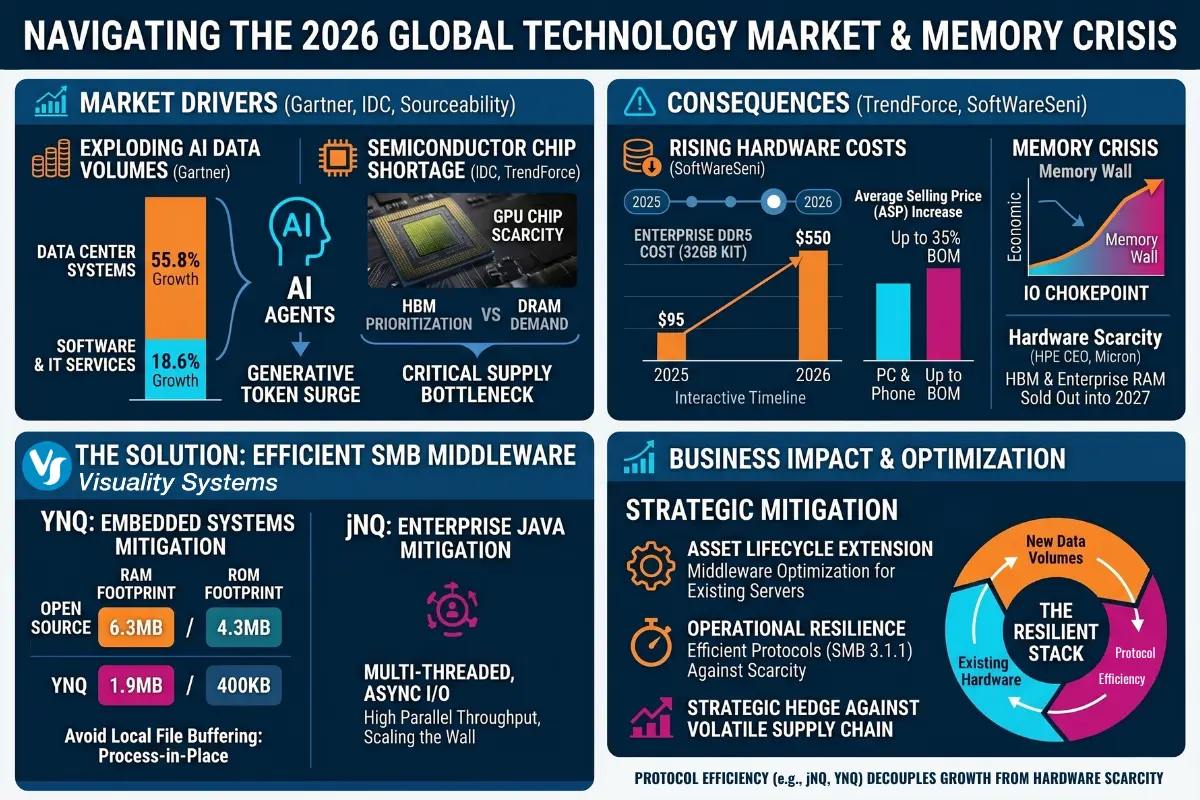

A detailed multi-panel infographic from Visuality Systems, titled 'Navigating the 2026 Global Technology Market & Memory Crisis.' Panel 1, 'Market Drivers,' links 'Agentic AI Swarms' and massive data growth (Gartner statistics) to 'Semiconductor Chip Shortage' (IDC, HPE sources). Panel 2, 'Consequences,' shows an upward graph of 'Enterprise DDR5 Costs' and 'Hardware Scarcity' sold out until 2027. Panel 3, 'The Solution: Efficient SMB Middleware,' details mitigation: 'YNQ for Embedded Systems' contrasts RAM footprint (1.9MB vs. 6.3MB) and 'jNQ for Enterprise Java' highlights technical mechanisms like Multi-Threaded, Async I/O. Panel 4, 'Business Impact,' explains 'Strategic Mitigation' and 'The Resilient Stack' loop to decouple growth from scarcity. Footnote links to sources: Protocol Efficiency (e.g., jNQ, YNQ) Decouples Growth from Hardware Scarcity

Use-Case Scenarios: Middleware as a Strategic Buffer

The practical application of these efficient middleware solutions provides a roadmap for navigating the 2026 crisis.

Industrial Edge AI: In manufacturing, sensors are generating petabytes of telemetry for real-time analysis. By integrating YNQ, these devices can offload non-critical data to centralized network storage via SMB 3.1.1, dedicating their limited, expensive local RAM entirely to the AI inference models that drive value.

Enterprise Managed File Transfer (MFT): Providers like Seeburger have migrated to jNQ to support high-concurrency environments. In scenarios where thousands of files are transferred per minute, jNQ’s ability to handle multi-threaded I/O with a minimal footprint ensures that the Java application is more resilient to the resource pressures common in large-scale file handling.

Medical Imaging: Diagnostic scanners generate high-resolution data that must be shared with Windows workstations for AI-assisted diagnostics. YNQ’s hardware independence allows it to run on the Real-Time Operating Systems (RTOS) like VxWorks found in these scanners, providing a secure, high-speed bridge without interfering with life-critical processing tasks.

Geopolitical Realities and the 2027 Outlook

The memory crisis is being further exacerbated by geopolitical instability, including trade tensions and supply chain disruptions. The “Just-in-Time” manufacturing model has collapsed, replaced by a “Just-in-Case” strategy that further inflates prices as vendors hoard existing inventory.

Relief is not expected until late 2027 or 2028, when new fabrication plants reach volume production. Until then, IT directors must manage “elevated” prices and “unprecedented” lead times. Asset recovery has become a critical budget offset; for example, the resale value of server-grade DDR5 memory has reached such peaks that decommissioning a 200-server pool can yield up to $200,000 in recoverable value.

Strategic Recommendations for a Memory-Constrained Era

To thrive in this environment, technical and financial leadership must adopt a multi-layered approach to optimization:

  • Audit Protocol Efficiency: Identify legacy or open-source stacks that consume excessive RAM/ROM. Moving from open source to YNQ or jNQ can yield 10x reductions in memory overhead.
  • Prioritize Zero-Copy Operations: Ensure file-sharing protocols can edit and manage data remotely without local transfers, preserving RAM for core application logic.
  • Extend Hardware Lifecycles: As hardware prices surge, focus on securing older systems with modern SMB 3.1.1 middleware to ensure they remain compatible and secure within a Zero-Trust framework.

Conclusion: Software as the New Hardware

The 2026 memory crisis is more than a supply chain issue; it is a fundamental shift where the ability to “do more with less” has become the primary competitive advantage. As AI continues to “suck all the oxygen out of the room” in the semiconductor market, the software stack must bear the burden of optimization.

Middleware solutions like jNQ and YNQ are no longer just technical utilities; they are strategic buffers against a volatile global economy. By providing the most resource-efficient implementations of the SMB 3.1.1 protocol available, Visuality Systems enables organizations to “scale the memory wall” and continue their AI initiatives despite the hardware scarcity of 2026. The organizations that survive this era will be those that recognized early on that in a world of hardware scarcity, software efficiency is the only true currency.

Don’t let hardware scarcity halt your AI innovation. Contact Visuality Systems today to evaluate how jNQ and YNQ can optimize your infrastructure and decouple your growth from the volatile memory market.

Raphael Barki, Head of Marketing, Visuality Systems

Raphael Barki, Head of Marketing, Visuality Systems

Share Via
Related Articles

Visuality systems uses technical, analytical, marketing, and other cookies. These files are necessary to ensure smooth operation of Voltabelting.com site and services and help us remember you and your settings. For details, please read our Privacy policy

Skip to content