
The Copyleft Paradigm and Commercial Reality
In the modern enterprise software ecosystem, secure, cross-platform file sharing and network communications are fundamental architectural requirements. This need is especially critical in heterogeneous environments where commercial edge devices, real-time operating systems (RTOS), and enterprise Java backend services must interact natively with Windows-centric networks and cloud-based file shares. To accelerate development cycles and establish file transfer capabilities, engineering teams frequently integrate open-source protocol libraries into their software architectures.
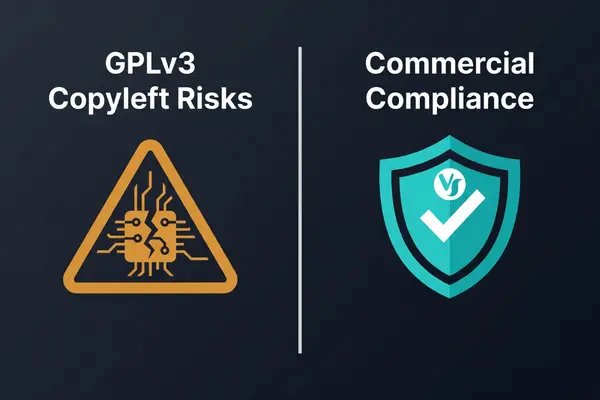
However, integrating open-source components governed by strong copyleft licenses, specifically the GNU General Public License version 3 (GPLv3), presents severe legal, compliance, and financial risks for commercial software vendors. For corporate legal, security, and compliance officers, embedding GPLv3 code is not a minor open-source oversight; it is an operational risk that can expose proprietary intellectual property (IP), dilute corporate patent portfolios, and compromise corporate valuation during mergers and acquisitions (M&A).
The foundational mechanism of copyleft licenses flips the concept of copyright. While standard copyright law enforces exclusive ownership and restricts unauthorized copying, copyleft uses the same legal framework to guarantee ongoing software freedom. When an organization distributes or “conveys” a product containing copyleft-licensed code, it is legally obligated to release the complete, original source code, along with any modifications and combined work, under the exact same copyleft terms.
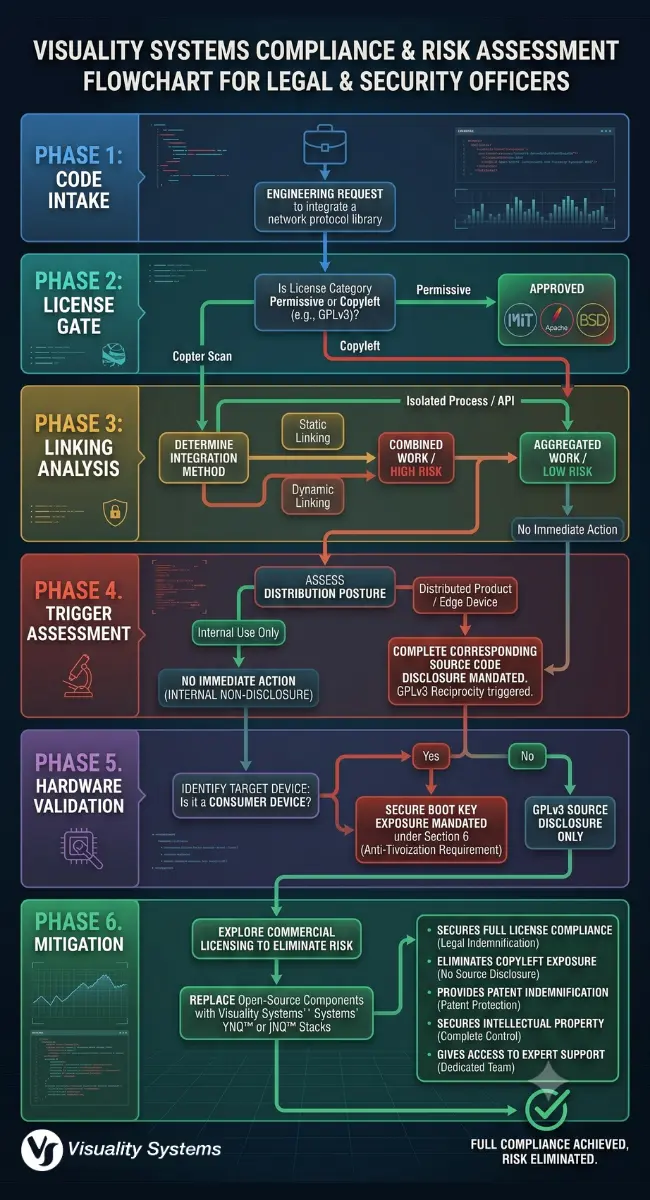
Under GPLv3, these obligations are governed by two distinct operational concepts: “propagation” and “conveying”. Propagation includes any activity that would make an entity liable for copyright infringement, such as copying, modifying, distributing, or making the software available to the public. Conveying is a specific subset of propagation that enables third parties to receive or make copies of the software. While private, internal use of GPLv3-licensed code does not trigger copyleft requirements, the moment the software is conveyed to a customer, whether embedded in a physical hardware device, provided as a client-side application, or distributed as a downloadable binary, the copyleft provisions are triggered. The organization must then make the complete Corresponding Source of the entire combined software work available to all recipients. This hereditary effect can strip a commercial software vendor of its proprietary licensing rights, forcing the public disclosure of its core commercial source code to competitors and customers alike.
Corporate Patent Portfolio Contamination and Retaliation Risks
For technology corporations, a robust patent portfolio is a critical defensive and offensive asset. GPLv3 introduces explicit, aggressive patent provisions designed to prevent companies from utilizing patents to restrict the software freedoms established by the license. These provisions present two distinct risks to corporate patent strategies.
The Explicit Patent Grant (Section 11)
Under Section 11, Paragraph 3 of GPLv3, any contributor who distributes a version of a GPLv3-licensed program automatically grants downstream users a non-exclusive, worldwide, royalty-free patent license under their “essential patent claims”. This license allows users to make, use, sell, offer for sale, import, and otherwise run and modify the contributor’s version.
If an enterprise modifies a GPLv3 network protocol library and conveys it as part of a product, the enterprise automatically grants a royalty-free license to its own proprietary patents that are essential to that implementation. This can result in an inadvertent, permanent dilution of valuable intellectual property.
The Patent Retaliation Clause (Section 10)
GPLv3 implements a defensive patent termination mechanism in Section 10, Paragraph 3. This clause states that a licensee may not initiate patent litigation alleging that the GPLv3-covered program, or any portion of it, infringes their patents. If a licensee initiates such litigation against the program, all copyright and patent permissions granted to that licensee under the GPLv3 are automatically terminated.
This creates an asymmetric risk profile for commercial entities. If an enterprise sues a competitor for patent infringement, and that competitor’s product utilizes the same GPLv3 program, the competitor can trigger the termination of the enterprise’s license to the GPLv3 code, creating massive business disruption and operational liability.
Cryptographic Key Disclosure: The GPLv3 Section 6 Anti-Tivoization Trap
For manufacturers of embedded devices, IoT hardware, medical equipment, and automotive systems, Section 6 of GPLv3 introduces a major hardware engineering obstacle known as the anti-tivoization clause.
Tivoization, a term derived from TiVo’s digital video recorders (DVRs), refers to the practice of incorporating copyleft-licensed open-source software into hardware devices while utilizing hardware-based cryptographic signatures, checksums, or secure boot mechanisms to prevent users from installing or executing modified versions of that software on the physical hardware. While the manufacturer complies with the literal terms of copyleft by providing the software’s source code, the physical device remains locked down, preventing any actual software modification.
To eliminate this loophole, Section 6 of GPLv3 mandates that if a covered work is conveyed in, with, or specifically for use in a “User Product” (defined as any tangible personal property normally used for personal, family, or household purposes), the distributor must provide the recipient with all Installation Information. GPLv3 defines Installation Information as any methods, procedures, authorization keys, or other information required to install and execute modified versions of the covered software on the device, ensuring that the continued functioning of the modified code is not prevented or interfered with solely because a modification has been made. This requirement effectively forces hardware manufacturers to hand over their secure boot keys, cryptographic signing certificates, or hardware verification bypass codes to consumer end-users.
For industries with strict safety and security certifications, the anti-tivoization clause introduces severe vulnerabilities.
- Automotive Industry: Connected vehicles must comply with rigorous safety standards regarding engine management, braking (ABS), and advanced driver-assistance systems (ADAS). Forcing automakers to provide keys enabling vehicle owners or third-party mechanics to flash modified, uncertified firmware onto the vehicle’s electronic control units (ECUs) bypasses functional safety parameters and invalidates regulatory compliance.
- Medical and Public Systems: Allowing users to alter code on medical monitors, infusion pumps, or smart grid endpoints compromises device integrity and presents critical cybersecurity risks.
While GPLv3 limits this requirement to “User Products,” the boundary is highly complex, and compliance officers generally refrain from integrating GPLv3 components in any edge device or embedded system to avoid the threat of key exposure.
Financial and M&A Valuation Consequences of License Non-Compliance
Open-source license compliance has evolved from a secondary legal concern to a primary focus of corporate governance, application security (AppSec), and corporate finance. Violating the terms of GPLv3 carries direct, measurable financial consequences.
Open-source license conditions are enforceable under copyright law. A violation of a copyleft condition constitutes copyright infringement, which grants the copyright holder access to immediate injunctive relief. For an enterprise dependent on distributed hardware or software systems, an injunction represents a catastrophic disruption, requiring companies to either immediately withdraw products from the market, open-source their entire proprietary software portfolio, or completely rewrite the software to remove the infringing copyleft code.
The Paris Court of Appeal awarded software company Entr’Ouvert over €900,000 in damages against major telecommunications operator Orange S.A.. The landmark lawsuit alleged violations of the GNU General Public License (GPL) version 2.0 when Orange failed to comply with open source copyleft disclosure requirements.
During corporate acquisitions, equity investments, or public offerings, acquiring entities perform thorough Software Composition Analysis (SCA) to generate a complete Software Bill of Materials (SBOM). Finding unmanaged GPLv3 components within the target’s core proprietary software represents a critical deal-breaker.
The Commercial Alternative: High-Performance, Patent-Shielded Connectivity
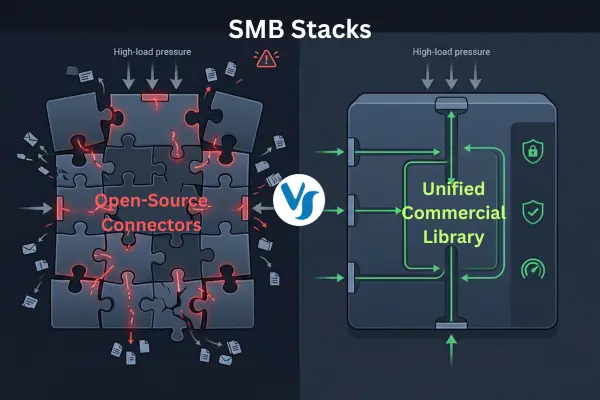
To mitigate the architectural and legal liabilities of copyleft network libraries, modern enterprises are transitioning to commercially licensed protocol implementations. Visuality Systems, an established global authority in secure protocol solutions, offers commercial, proprietary SMB stacks designed to resolve compliance risks while enhancing system performance and security.
By utilizing Visuality Systems’ commercial solutions, developers bypass open-source liabilities and gain access to fully maintained libraries that carry explicit intellectual property and patent protection agreements directly with Microsoft.
Commercial developers can explore Visuality Systems’ core solutions:
- YNQ – The premier commercial C-language client and server stack designed for resource-constrained systems, embedded hardware, and real-time operating systems (RTOS).
- jNQ – A pure Java client library that serves as the leading replacement for legacy, insecure open-source Java libraries.
Proven Industrial Case Studies
- Multifunctional Printers (MFPs): The YNQ Client is integrated into more than 340 million high-end printing devices globally, serving as the de facto standard for secure “Scan to Folder” functionality. Running YNQ on an MFP enables the scanner to browse corporate networks, discover shared folders, and transfer documents securely using SMB3 end-to-end encryption.
- Aerospace & Defense Cockpit Systems: In high-performance avionics, transferring massive, multi-gigabyte aircraft navigation maps over slow protocols like FTP can introduce system lag. Visuality Systems’ stacks are deployed natively in cockpit screens running VxWorks and backend storage systems running INTEGRITY. Because SMB allows files to be queried, read, and edited in place over the network without requiring a full file download, map scaling and real-time visualization latency is minimized.
- Automotive Test Stands and Prototype Vehicles: During manufacturing test runs, vehicles generate large volumes of sensor data. Automakers integrate YNQ into QNX-based real-time test stands and Windows CE prototype vehicles, allowing test parameters to be dynamically updated via SMB while test data is continuously streamed to a centralized database server using secure, encrypted SMB3 channels.
Mitigating Copyleft Risks: Next Steps for Enterprise Software Governance
To protect proprietary intellectual property and prevent copyleft compliance gaps, commercial software vendors must establish a structured, proactive compliance protocol.
- Legal and engineering departments should draft a formal, unified open-source software usage policy. This policy should explicitly categorize licenses into three categories:
- approved (MIT, Apache 2.0)
- manual review required (LGPL, MPL)
- restricted/forbidden (GPLv2, GPLv3, AGPL)
- Automated Software Composition Analysis (SCA) must be integrated directly into the continuous integration and deployment (CI/CD) pipelines. These tools scan dependencies at commit-time, blocking any unauthorized GPLv3 components before they can contaminate the codebase.
- Organizations should maintain a detailed Software Bill of Materials (SBOM) for all distributed products. This documentation ensures compliance with customer contracts, simplifies audit requests, and protects corporate valuation during due diligence and M&A transactions.
- If open-source modules must be utilized, strict architectural boundaries must be enforced. Open-source elements should run in independent process spaces, communicating only through standard, simple inter-process communication (IPC) protocols (such as command-line execution or isolated microservices), avoiding any shared address space linking.
Finally, the most effective compliance strategy is to eliminate open-source copyleft and patent risks entirely by transitioning to commercial, fully supported, and indemnified protocol stacks.
To safeguard intellectual property, protect corporate patent portfolios, and ensure seamless compliance with modern network security mandates, enterprises are invited to contact the expert engineering team at Visuality Systems. Requests for a technical consultation or a free evaluation of the YNQ (C-language) or jNQ (Java) stacks can be sent directly to Visuality Systems via [email protected].

Tal Widerman, CEO, Visuality Systems