

In the world of healthcare interoperability, we often focus on the glamorous side of data exchange: parsing HL7 v2 messages, transforming complex FHIR resources, or orchestrating multi-facility API webhooks. Yet, in actual enterprise production environments, a massive percentage of clinical data movement relies on a much older, less glamorous reality: the network file transfer.
Every single day, multi-million dollar legacy medical imaging devices (PACS), automated laboratory instruments, and third-party billing utilities dump mission-critical patient data onto local network shares. From there, enterprise interface engines- such as Mirth Connect (Open Integration Engine) – must pick up, process, and route these files to modern hybrid cloud environments.
Historically, Java-based systems running these workloads relied on the open-source JCIFS library to handle Server Message Block (SMB/CIFS) network file operations.
But if you run an integration team, you already know the nightmare that has quietly unfolded over the past few years. The original JCIFS library is effectively dead, locked forever in the obsolete and dangerous world of SMB1. Forcing an enterprise data pipeline to upgrade to modern, secure SMB2/3 with encryption while avoiding classpath entanglement has historically been a major bottleneck, one that organizations have successfully resolved using jNQ, our production-proven Java SMB Client library for secure file connectivity.

The Context: The High-Stakes Compliance Collision
Healthcare infrastructure is caught in a tight vice between rigid security standards and un-upgradable legacy hardware.
On one side, the Cybersecurity and Infrastructure Security Agency (CISA) and enterprise security teams have spent years ordering the total deprecation of SMBv1 due to catastrophic vulnerabilities (such as WannaCry). Under modern compliance frameworks, moving Protected Health Information (PHI) over unencrypted network channels is an immediate failure. HIPAA requires strict administrative and technical safeguards to protect data-in-transit (45 CFR § 164.312(e)(1)), making SMB3 with mandatory transport encryption the absolute baseline requirement.
On the other side sits the operational reality: a hospital’s diagnostic equipment cannot simply be patched or replaced on a whim. These devices often continue to output flat files to shared folders using disparate, mismatched storage protocols. The integration engine is forced to act as the universal bridge, connecting legacy on-premise infrastructure to secure cloud object storage (like AWS S3 or Azure Blob).
Deep Dive: The JCIFS Dependency Trap
When Java developers attempt to transition their file-handling infrastructure from unencrypted SMB1 to secure SMB3, they immediately hit a brick wall known as JCIFS Dependency Hell.
To understand why this happens, we have to look at the fragmented evolution of Java SMB libraries:

The Breaking API Architecture
The original, widely used jcifs-1.3.19 library handles configurations via global system properties (Config.setProperty()). This works fine until you need to connect to two different file shares simultaneously using different sets of credentials or distinct SMB dialects. It is a completely static, non-thread-safe architecture.
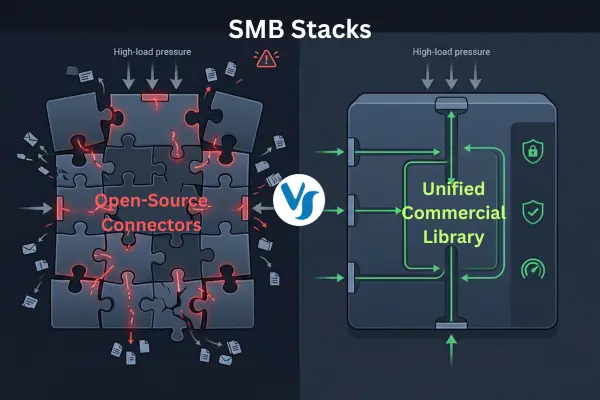
To get SMB2/3 support, developers generally look at modern open-source forks or completely rewritten open-source Java SMB libraries. Neither of these approaches is a drop-in replacement.
Context Initialization & Authentication Friction
Upgrading to modern open-source alternatives requires tearing out the old static configuration model and replacing it with a context-based approach utilizing multiple configuration objects, explicit context initializers, and credential wrappers. Look at the sheer amount of boilerplate code required just to initialize a secure authenticated context in modern Java environments:
// Boilerplate to initialize a secure authenticated context
Properties props = new Properties();
props.setProperty("jcifs.smb.client.minVersion", "SMB210");
props.setProperty("jcifs.smb.client.maxVersion", "SMB311");
props.setProperty("jcifs.smb.client.encryptionEnabled", "true");

try {
      CIFSContext baseContext = new BaseContext(new PropertyConfiguration(props));
      CIFSContext authenticatedContext = baseContext.withCredentials(
            new NtlmPasswordAuthenticator("DOMAIN", "username", "password")
      );

      // ... use authenticatedContext
} catch (Exception e) {
      // Handles both ConfigurationException and library-specific runtime errors
}
If your integration engine needs to dynamically manage hundreds of routes, initializing, caching, and tearing down these complex contexts without leaking file descriptors or network sockets becomes an immense operational burden.
Cryptographic and Runtime Clashes
The friction deepens when running these libraries on modern Java runtimes (Java 11, 17, or 21). Secure SMB3 requires complex AES-128-GCM or AES-256-GCM encryption. While modern JDKs natively support GCM via the standard JCA provider, several open-source SMB libraries remain tightly coupled to third-party providers like Bouncy Castle to handle specialized session key derivation or legacy fallback routines.
When these underlying library dependencies clash with the specific version of Bouncy Castle already running inside your enterprise application server, it triggers runtime exceptions, class-loading collisions, or unexpected NoSuchAlgorithmException errors. A minor update to a security library in an unrelated part of your application can instantly break your entire clinical file-ingestion pipeline.
The Interface Engine Bottleneck (The Mirth Connect Reality)
This technical debt directly impacts deployments running on highly robust interface engines like Mirth Connect, where a single cryptographic collision can quietly halt critical HL7 or DICOM (Digital Imaging and Communications in Medicine) routing channels.
Mirth Connect is widely celebrated for its routing capabilities and channel management. However, when an enterprise security mandate suddenly demands that a channel switch from legacy SMB to secure, encrypted SMB3, integration teams run into a structural classpath limitation common to the broader Java ecosystem.
Because of how shared Java Classloaders operate within application servers, updating or dropping a newer file-handling JAR file into the Mirth /custom-lib directory to support a new secure dialect can inadvertently trigger classpath conflicts with other active channels. It is a challenge inherent to the underlying shared JVM (Java Virtual Machine) runtime environment rather than the engine itself.
💡 Architectural Note: The NextGen Connect (Mirth) Ecosystem
When deploying data pipelines in modern healthcare environments, it is important to note that the classic “Mirth Connect” ecosystem has evolved into fractured paths:
- NextGen Connect – the commercial enterprise version (managed by NextGen Healthcare).
- Open Integration Engine (OIE) – a community-driven open-source fork.
- BridgeLink – an open-source fork maintained with available commercial enterprise support via Innovar Healthcare.
Because these variants handle shared libraries, classloading, and underlying JVM cryptographic extensions differently, dropping a tightly coupled, legacy open-source SMB library into any of these environments introduces severe operational fragility across your channels.
Custom Java Extensions (And the Maintenance Overhead)
To bypass these environmental library collisions, integration architects frequently take advantage of Mirth’s excellent extensibility, leveraging custom Java classes directly within JavaScript transformer steps or JavaScript Writer nodes.
While this programmatic flexibility is one of the engine’s greatest strengths, manually implementing low-level socket, stream, and credential operations inside channel scripts introduces long-term maintenance overhead:
- Boilerplate Explosion: A channel that should simply write a file to a secure endpoint ends up carrying pages of complex Java network streaming boilerplate, socket lifecycle commands, and verbose credential-handling routines.
- Opacity and Maintenance: This custom connection logic becomes buried deep inside individual channel configurations. When domain structures change, server paths are updated, or security parameters must be adjusted, developers must manually open, edit, and redeploy code fragments across dozens of distinct channels.
- Loss of Out-of-the-Box Visibility: Standard interface connection monitoring, native retry policies, and automated connection pooling are bypassed, meaning operations teams lose standard dashboard visibility if a target network share drops offline.
Architectural Requirements for a HIPAA-Ready Infrastructure
To break free of this loop, enterprise healthcare organizations must treat storage protocol integration as a distinct, isolated architectural layer. A robust, HIPAA-compliant file pipeline cannot be built on brittle, channel-specific scripts. It must fulfill four foundational criteria:
Requirement | Implementation Reality |
End-to-End Encryption | Strict, programmatic enforcement of SMB3 encryption dialects (SMB300, SMB311) and modern transport layer security for cloud endpoints. |
Zero Global State | Contexts, authentication domains, and protocol definitions must be entirely isolated per connection instance to ensure thread safety under heavy workloads. |
The application code executing the business logic should have zero awareness of whether the target file destination is a local Windows server or an AWS S3 bucket. | |
Comprehensive Audit Logging | Native tracking of file access, cryptographic handshakes, and transmission statuses to provide a clear audit trail for compliance. |
The Solution: Bypassing Boilerplate with a Unified Storage API
Instead of forcing your engineering team to become experts in low-level SMB socket management, library forks, and breaking dependency upgrades, the logical solution is to implement an administrative abstraction layer.
While jNQ enables dedicated, secure Java SMB connectivity, enterprise architectures shifting toward multi-protocol environments require a broader multi-storage framework. Taking advantage of our deep protocol and network stack expertise, we have engineered an upcoming, next generation Java storage connector suite to act as this unified abstraction layer. It collapses the entire multi-protocol nightmare – native SMB (all versions), NFS, and major cloud providers – under a single, elegant, and unified Java API.
What This Looks Like in Practice
By wrapping the complex authentication, cryptography, and connection pooling mechanics behind a clean interface, your integration scripts contract from hundreds of lines of fragile boilerplate down to an intuitive, highly readable operation.
Imagine replacing pages of error-prone JCIFS or complex open-source initialization code with a simple, direct pattern:
// Conceptual view of a unified, abstract file operation
// Credentials pulled from a secret store at runtime, not hardcoded
Credentials creds = vault.getCredentials("pacs-server");
StorageURI endpoint = StorageURI.parse(“smb3://pacs-server/imaging_data”);
StorageClient storage = StorageSuite.newClient(endpoint, creds);try (InputStream in = storage.openInputStream(“chest_xray_1042.dcm”)) {
// Process the imaging file; transport, auth, and connection lifecycle are managed for you
}
The Architectural Benefits
- Complete Isolation from Integration Friction: Utilizing a completely distinct, multi-protocol architecture specifically engineered for diverse storage environments, this upcoming suite natively embeds and manages file and object protocols directly at the application layer, completely bypassing the shared Java classloader environment. Upgrading your host system or changing security settings won’t cause classpath conflicts or break existing channels.
- Instant Hybrid Cloud Agility: Because the API is entirely unified, existing jNQ environments or new implementations looking to route healthcare data from a legacy on-premise share to an enterprise AWS S3 or Azure cloud bucket can do so by simply changing a configuration string, requiring zero structural rewrites of the core data routing logic.
- Engineered for High-Throughput Healthcare Scaling: Built-in connection pooling, resource management, and robust error-recovery models ensure that your integration engine maintains maximum performance and zero file-descriptor leaks, even when handling millions of clinical messages per day.
Conclusion: Stop Debugging Infrastructure; Focus on Data
Your integration team’s primary mission is to ensure that critical patient data flows smoothly, securely, and without interruption to the point of care. Every hour an engineer spends debugging a Bouncy Castle dependency clash, wrestling with a custom open-source context configuration, or rewriting a brittle file-transfer script inside a Mirth channel is an hour stolen from high-value clinical optimization.
By decoupling your application logic from low-level network protocol management, you completely eliminate the infrastructure overhead that slows down enterprise deployments.
If your data engineering pipelines are currently hitting protocol bottlenecks, legacy library limitations, or custom code debt, it’s time to transition to an enterprise-grade solution. Reach out to our team today to deploy jNQ for immediate SMB3 compliance, or to get an exclusive, early technical deep dive into our upcoming unified Java connector suite.
Disclaimer
Mirth Connect is a registered trademark of NextGen Healthcare. Open Integration Engine (OIE) and BridgeLink are independent open-source forks of the historical Mirth Connect codebase. This article is for informational purposes only; jNQ and our upcoming Java suite are independent products and are not affiliated with, sponsored by, or endorsed by NextGen Healthcare, the OIE Steering Committee, or Innovar Healthcare.

Raphael Barki, Head of Marketing, Visuality Systems