
For decades, the enterprise storage landscape was defined by clear boundaries. If you were in a Windows-centric environment, you utilized SMB. If you were in a high-performance Linux cluster, you relied on NFS. These protocols were the stable pillars of data infrastructure, and mastering them was the key to building reliable software.
However, as we look at the evolving data landscape, those pillars are no longer isolated. The modern Java application has become protocol-diverse by necessity. A single workflow might now require pulling raw data from a legacy Windows Server (SMB), processing it on a high-speed Linux mount (NFS), and archiving the result in a cloud-native bucket (S3).
This shift has introduced a new, complex challenge for software architects: Protocol Fragmentation.
Key Takeaways for Software Architects
- Protocol fragmentation leads to architectural debt and complex maintenance.
- Hard-coding storage logic limits infrastructure flexibility in hybrid cloud environments.
- A unified Java network protocol library simplifies the “Semantic Gap” between file systems and object storage.

The Hidden Costs of Protocol Fragmentation
In many traditional architectures, applications are hard-coded to a specific protocol. When business logic is tightly coupled with protocol-specific classes and error-handling routines, the system becomes rigid.
This fragmentation introduces several significant hurdles for the modern enterprise:
- The Semantic Gap: SMB is fundamentally stateful, using tree-connects and file-locking; S3 is stateless, utilizing RESTful GET/PUT operations. Bridging these differences within an application’s source code often leads to “leaky abstractions.”
- Authentication Complexity: Managing the intersection of Kerberos (SMB), RPCSEC_GSS (NFS), and OAuth or IAM roles (Cloud Storage) within a single application creates a fragmented security posture.
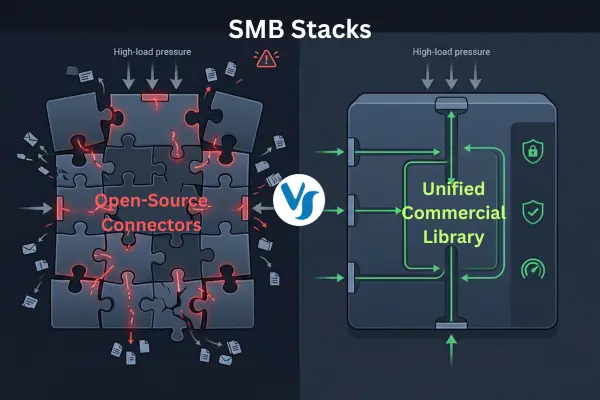
- Architectural Debt: Every time a new storage integration is required, whether it is a move to SharePoint or a new S3-compatible provider, developers must write, test, and maintain entirely new connector logic.
Shifting Toward Java Protocol Agnosticism
To build resilient, future-proof software, there is a growing movement toward Protocol Agnosticism. This design philosophy suggests that the core business logic of a Java application should be decoupled from the transport layer.
In an agnostic architecture, the application interacts with a Unified Storage API. The code only needs to understand how to read(), write(), or list(). The underlying complexity of whether that data is sitting on a NAS, a SAN, or in the cloud is handled by a specialized connectivity layer.
This approach offers several key advantages:
- Cleaner Java Codebases: Developers focus on data processing rather than the nuances of network packet handling.
- Infrastructure Flexibility: IT managers can migrate storage backends (e.g., moving from NFS to S3) without requiring a code refactor.
- Standardized Security: A unified layer allows for a consistent way to map identities and permissions across different network environments.
The Advantage of Pure Java Connectivity
In containerized and Kubernetes environments, the traditional method of using OS-level mounts is increasingly viewed as a bottleneck. Relying on the host operating system to manage SMB or NFS mounts introduces security risks and complicates horizontal scaling.
A more modern approach involves using Pure Java implementations. By handling the protocol stack directly within the JVM, applications gain total independence from the host OS. This enables the creation of Virtual Mounts, where the Java application can talk to any storage target (SMB, NFS, or Object Storage) with the same level of control and performance, regardless of the underlying platform.
The Metadata Gap: A Technical Perspective
Mapping different storage languages into a single interface requires solving the Metadata Gap. When data moves between protocols, its identity must be preserved despite fundamentally different structures.
Feature | SMB / NFS | Object Storage (S3 / SharePoint) |
Structure | Hierarchical (Directories) | Flat (Buckets / Key Prefixes) |
Permissions | ACLs and POSIX bits | IAM Policies / Graph API Permissions |
State | Stateful (Open handles) | Stateless (Request/Response) |
Metadata | Extended Attributes (EA) | Object Tags / Custom Properties |
The Solution: to achieve true agnosticism, a connectivity layer must translate these concepts in real-time. For instance, it must simulate a folder hierarchy for S3 or map Windows SID-based permissions to cloud identities. Solving this at the library level ensures that the application remains portable across any network environment.
Conclusion: The Move to a Unified Stack
The era of the single-protocol application is ending. As data becomes more distributed across on-premise and cloud environments, the ability to navigate a multi-protocol world is becoming a baseline requirement for enterprise Java development.
Whether building Managed File Transfer (MFT) tools, document management systems, or high-throughput data pipelines, the focus is shifting. The goal is no longer just to connect to a server, but to create a unified bridge across the entire network landscape.

Lilia Wasserman, VP R&D, Visuality Systems