

In the world of IT infrastructure, change usually happens in waves. But for embedded systems – the printers, medical devices, and industrial controllers that quietly power our world – those waves often feel more like tsunamis.
Right now, a major shift is occurring. Microsoft is aggressively pushing to deprecate NTLM (New Technology LAN Manager), the 30-year-old authentication workhorse. As Windows moves toward a “secure-by-default” posture, the fallback to NTLM is being systematically removed in favor of a modern, Kerberos-centric future.
For manufacturers and developers using embedded Linux or RTOS, this isn’t just a “Windows update” problem. It’s a connectivity crisis. If your device cannot talk Kerberos, it may soon find itself locked out of the modern enterprise network.

The YNQ Advantage: Future-Proofing Today
This is where YNQ comes in. As a high-performance SMB stack designed specifically for non-Windows platforms (Linux, VxWorks, Integrity, etc.), YNQ was built to handle the complexities of modern Windows security without the overhead of open-source alternatives.
The following architecture demonstrates how YNQ replaces legacy, vulnerable NTLM handshakes with a robust, multi-stage Kerberos flow, managing the heavy lifting of ticket exchanges and DNS resolution natively within your device.
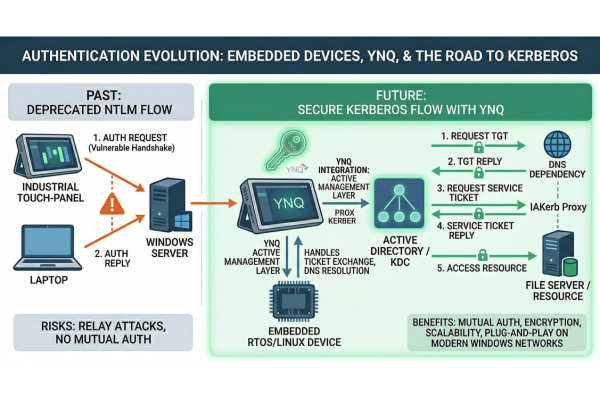
While Kerberos is still technically rooted in a shared secret (such as a machine account password or keytab), its primary advantage is that it moves the device toward a credential-less workflow on the wire. Once the initial Ticket Granting Ticket (TGT) is obtained, a process further simplified in restricted networks by IAKerb, the actual password never travels across the network again. By using YNQ to manage this encrypted ticket lifecycle, your device achieves the seamless, high-security connectivity modern enterprises demand, without the vulnerabilities of legacy password-exchange protocols like NTLM.
By integrating YNQ, your engineering team can bypass “authentication debt” and deploy a solution that is secure by default:
- Native Kerberos Support: YNQ provides built-in support for the full Kerberos lifecycle shown above, including TGT and Service Ticket requests, ensuring your device is ready for an NTLM-free enterprise.
- Small Footprint, Big Security: While Kerberos is traditionally “heavy,” YNQ is optimized for RTOS and embedded Linux, providing advanced SMBv3 security features like encryption and pre-authentication integrity with minimal RAM and CPU impact.
- Commercial Reliability: Unlike open-source projects that may lag behind Microsoft’s rapid deprecation cycles, YNQ offers a supported roadmap that keeps pace with the latest Windows Server releases.
Don’t Get Left Behind
The transition to a secure, ticket-based authentication is no longer a “roadmap item” – it is the current reality. Ensuring your embedded devices support Kerberos now is the only way to avoid the looming wall of authentication debt.
Are you ready to transition your devices to a Kerberos-based environment? Contact our experts at Visuality Systems to learn how YNQ can secure your product’s future.